
Hire a LearnDash developer in the UK and you run into a problem the US-focused cost guides never mention. The hourly rate is only one line on the invoice. Whether you need to add VAT, whether IR35 applies to the contract, and where your students’ personal data is legally allowed to sit are three separate questions that a generic “how much does a developer cost” article from an American site simply does not answer, because none of those three things exist in US law at all.
I build on LearnDash for a living, and I have watched UK-based course creators get a clean hourly quote from a freelancer, sign it, and then discover three months later that HMRC has a view on the arrangement they never asked about. This guide covers the real GBP rate bands, the VAT threshold that actually applies in 2026, the IR35 rules that changed in April 2026, and the UK GDPR data residency question, all specific to hiring a LearnDash developer rather than general freelance advice repeated from a tax blog.
Quick Answer
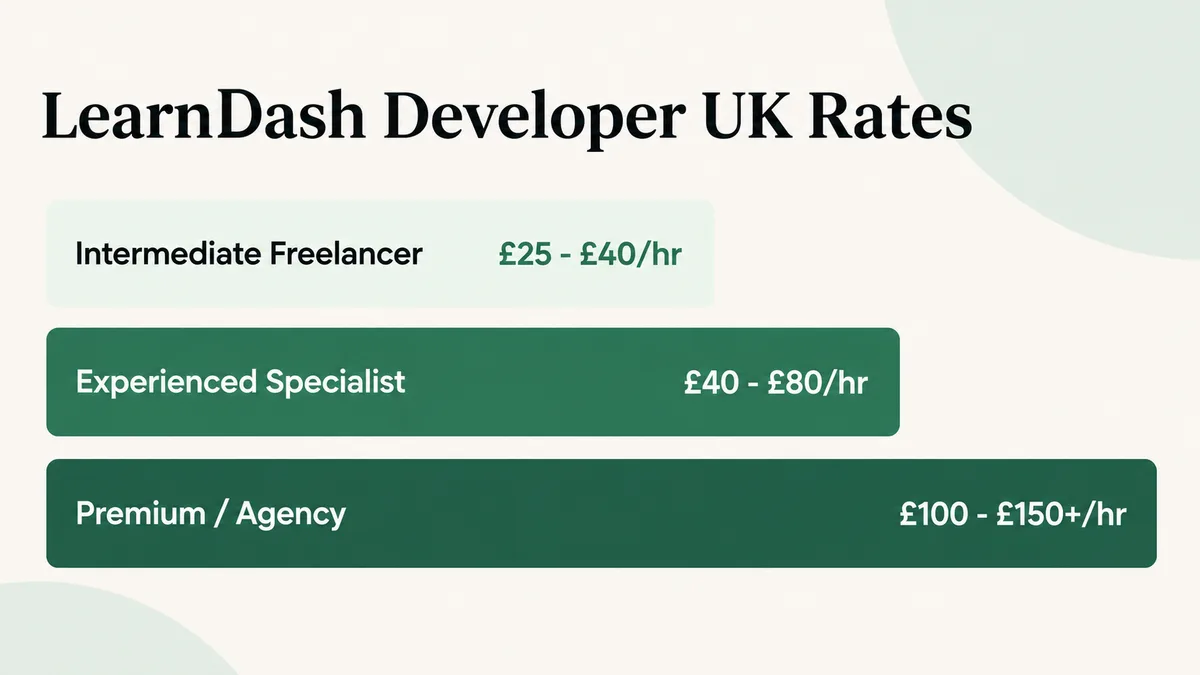
A real LearnDash developer UK rate runs roughly £25 to £40 per hour for an intermediate freelancer, £40 to £80 per hour for an experienced LearnDash specialist, and £100 to £150 or more per hour for a premium specialist or agency. Fixed-price builds commonly run £1,500 to £3,000 for a basic site and £5,000 to £15,000 or more for a custom build with GDPR compliance and accessibility work included. On top of the rate, check whether the developer needs to charge VAT (the 2026 threshold is £90,000 of taxable turnover), whether IR35 applies to the engagement if you are hiring through a UK limited company, and where your students’ personal data will actually be hosted.
📋 What’s Covered
02How Do UK LearnDash Rates Break Down by Experience Level?
03Do I Need to Pay VAT on a LearnDash Developer’s Invoice?
04Does IR35 Apply When I Hire a Freelance LearnDash Developer?
05Where Does UK GDPR Say My Students’ Data Actually Has to Live?
06Is a UK-Based Developer Actually Worth the Extra Cost Over Offshore?
07What Should I Ask Before Signing With a UK LearnDash Developer?
08What Red Flags Are Specific to the UK LearnDash Market?
09How Do I Screen a UK LearnDash Developer in One Afternoon?
10How Do I Avoid Getting the IR35 Call Wrong?
11Frequently Asked Questions
What Does It Really Cost to Hire a LearnDash Developer in the UK?
LearnDash is a self-hosted WordPress plugin, not a closed SaaS platform, so the “developer” title covers a wider range of real work in the UK than it does for a hosted course tool. Some listings quote a rate for someone who follows LearnDash’s own setup documentation. Others quote a rate for a genuine WordPress specialist who can diagnose a broken certificate trigger, untangle a caching conflict, or build a custom reporting dashboard against LearnDash’s hook system. Both numbers are real. They are not pricing the same job.
I have already covered the general LearnDash developer cost in US dollar terms, and the underlying rate bands translate directly into GBP once you convert them. What that earlier guide does not cover, because it genuinely does not apply outside the UK, is VAT, IR35, and UK GDPR data residency. Those three items change what a UK-based quote actually costs you once the invoice lands, and none of them show up on the headline hourly rate.
How Do UK LearnDash Rates Break Down by Experience Level?
UK-specific rate research for LearnDash work settles into three bands, consistent across the dedicated UK LearnDash cost guides that exist and the general UK WordPress developer rate data behind them.
£25 to £40 per hour: an intermediate freelancer with working LearnDash knowledge, usually following the plugin’s own documentation for setup, lessons, and quizzes. Fine for a single, straightforward course. Not the person to debug a plugin conflict or a broken enrollment trigger.
£40 to £80 per hour: an experienced WordPress and LearnDash specialist with a real portfolio and coding ability. Reasonable for most course sites with one or two membership tiers and a standard WooCommerce or MemberPress integration.
£100 to £150 or more per hour: a premium specialist or an agency handling custom add-on development, complex integrations, or a migration carrying real student progress and certificates from another platform. UK agencies tend to sit at the higher end of this band once project management overhead is included.
£1,500 to £3,000 fixed, basic build: a single-course site with a standard WooCommerce checkout, no unusual integrations.
£5,000 to £15,000 or more fixed, custom build: a fully custom platform with WooCommerce integration, GDPR compliance work, accessibility auditing, and payment configuration bundled into one project.
Those figures are the developer’s gross quoted rate. They do not yet tell you whether VAT gets added on top, or whether the engagement counts as employment for tax purposes under IR35 if you are paying through a UK limited company. Both change the real number you end up paying, and neither question comes up when you are hiring a freelancer based outside the UK.
Do I Need to Pay VAT on a LearnDash Developer’s Invoice?
Whether a quote includes VAT depends entirely on the developer’s own turnover, not on the size of your project. As of the 2026/27 tax year, a UK sole trader or limited company only has to register for VAT once their taxable turnover crosses £90,000 in a rolling 12-month period, a threshold that has held since April 2024 and was confirmed unchanged at the Spring Statement 2026. You can check the current VAT registration rules directly on GOV.UK rather than trusting a number from any article, including this one, since thresholds do get revisited.
A smaller freelance LearnDash developer, especially one early in their business, is often below that threshold and will not charge VAT at all. A larger UK agency almost always is registered, which means a 20% VAT charge sits on top of whatever hourly or project rate you were quoted. Neither situation is a red flag on its own. The mistake is assuming a quote is VAT-inclusive without asking, because a £5,000 fixed-price build from a VAT-registered agency is actually a £6,000 invoice once VAT lands, and that gap is easy to miss when you are comparing three proposals against each other.
If you are hiring a developer based outside the UK entirely, UK VAT registration generally does not apply to their invoice in the same way, though your own business can carry separate reverse-charge obligations depending on how the engagement is structured. Confirm this with your own accountant rather than assuming either way, since it depends on your business’s VAT status, not just the developer’s.
Do this: Ask directly whether a quote is VAT-inclusive or VAT-exclusive before comparing it to another proposal, and confirm the developer’s VAT registration status in writing.
Does IR35 Apply When I Hire a Freelance LearnDash Developer?
IR35, the UK’s off-payroll working rules, decides whether a contractor working through their own limited company should be taxed broadly like an employee of your business or like a genuinely independent business. It only becomes your problem as the hiring business, rather than purely the contractor’s, if you are a UK limited company engaging a developer who also operates through a UK limited company, often called a personal service company. A sole trader hiring client, or a business engaging a developer who invoices directly as an individual rather than through their own limited company, sits outside the specific mechanics IR35 was built around.
From 6 April 2026, the size thresholds that decide who determines IR35 status changed meaningfully: UK company size limits for this purpose rose to £15 million turnover and £7.5 million balance sheet, reclassifying roughly 14,000 companies from medium to small. For a medium or large hiring company, you are responsible for issuing a formal Status Determination Statement to the contractor, explaining whether the engagement falls inside or outside IR35 and why. For a small company under the new thresholds, that responsibility shifts back to the contractor’s own limited company to self-assess.
Most course creators hiring a single LearnDash developer are a small business by these thresholds, which puts the self-assessment burden on the contractor rather than on you directly. That does not mean you can ignore the question. If HMRC later decides the real working relationship looked like employment, how much day-to-day control you exercised, whether the developer could send a substitute, whether they worked exclusively for you, that assessment still affects both parties. HMRC’s own Check Employment Status for Tax tool is the standard way to get a documented answer before a dispute arises, and keeping that result on file costs nothing.
Do this: Run the engagement through HMRC’s CEST tool before signing, and keep a copy of the result alongside the written scope, regardless of which side is technically responsible for the determination.
Where Does UK GDPR Say My Students’ Data Actually Has to Live?
This is the question I get asked most often by UK course creators, and the honest answer surprises most of them: UK GDPR does not require your student data to be physically stored on UK servers. There is no blanket data residency rule written into the law. What it requires instead is that personal data is processed lawfully and securely, and that any transfer of that data outside the UK uses a recognized lawful mechanism.
That picture changed in a specific, dated way this year. The Data (Use and Access) Act 2025 introduced a new data protection test for international transfers, and the data protection provisions took effect on 5 February 2026. The new test asks whether the destination country’s protections are “not materially lower” than the UK’s own standard, a deliberately less rigid bar than the old test, but still a real compliance question for any WordPress host sitting outside the UK or the EEA. The ICO’s own international transfers guidance, reissued in January 2026 to reflect the new law, walks through how to run that assessment.
For a LearnDash site specifically, “where personal data lives” covers more than most people assume: the WordPress database holding student enrollment and progress records, media uploads, backup copies, and any logging plugin capturing IP addresses or activity. A developer who has actually thought about this will be able to tell you where your hosting provider’s servers physically sit and whether any third-party integration, an email service, a certificate-generation tool, a CRM, moves student data outside the UK or EEA as part of normal operation.
Nothing here legally forces you onto UK-only hosting. The practical, lower-effort path most UK course businesses take is defaulting to UK or EEA-based hosting and integrations for anything touching student data anyway, simply because it sidesteps the international transfer assessment entirely rather than documenting a justification for skipping it.
Do this: Ask your developer to list every tool in the stack that touches student personal data and where each one physically hosts that data, not just where your main WordPress install sits.
Is a UK-Based Developer Actually Worth the Extra Cost Over Offshore?
A UK-based LearnDash developer costs more per hour than an offshore freelancer quoting in dollars or rupees, and the gap is real, often two to three times the rate for comparable skill. What that extra cost buys is not always obvious from the outside.
The genuine advantages are a shared working day for real-time calls without scheduling across a large time difference, direct familiarity with the UK GDPR and IR35 questions covered above without you having to explain them from scratch, and a UK-registered business that is easier to pursue through UK courts if a dispute ever escalates that far. The genuine downside, beyond the rate itself, is a smaller pool of LearnDash-specific UK specialists compared to the global market, which can mean a longer search to find someone with real hook-level experience rather than surface-level plugin configuration.
An offshore developer with strong LearnDash experience is a perfectly reasonable choice for a straightforward build with no unusual data residency sensitivity. Where UK-based hiring earns its premium is on a project that genuinely touches sensitive student data, health or financial information bundled into a course, or a compliance-heavy niche, where the extra cost buys someone who already understands the legal environment you are both operating in rather than learning it mid-project.
What Should I Ask Before Signing With a UK LearnDash Developer?
Beyond the general LearnDash vetting questions I covered in how to hire a LearnDash developer without getting burned, a UK engagement adds a short list of its own.
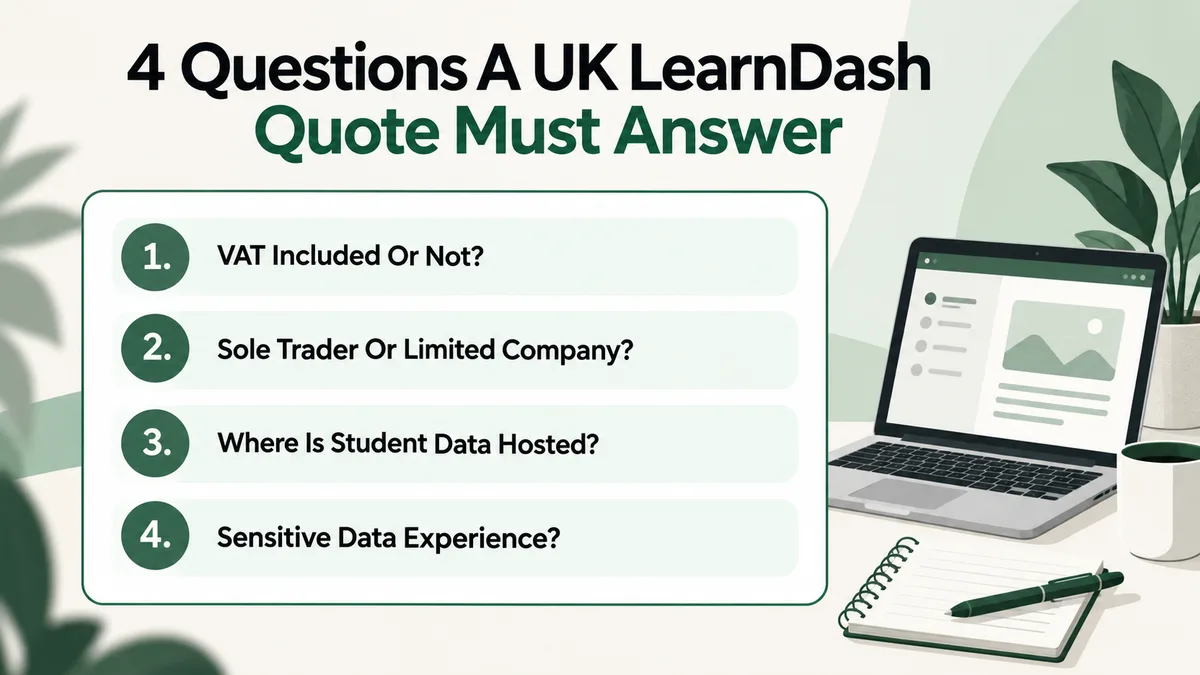
Is your quote VAT-inclusive or exclusive? Get this in writing before comparing proposals against each other.
Are you invoicing as a sole trader, a limited company, or through an umbrella company? This directly shapes whether IR35 is even a relevant question for the engagement.
Where will my students’ data physically be hosted? Get the real server location and the hosting provider’s name, not a vague “cloud hosting” answer.
Have you built a LearnDash site handling sensitive personal data before? A straightforward course and a certification tied to regulated training are not the same compliance weight.
What Red Flags Are Specific to the UK LearnDash Market?
Some of these overlap with general LearnDash hiring red flags. These four are specific to the UK side of the engagement and worth watching for separately:
- A quoted rate with no mention of VAT status at all, leaving you to discover a 20% markup on the first invoice.
- A developer who cannot answer a basic question about where their hosting physically sits when your course involves regulated or sensitive student data.
- A UK limited company contractor who insists IR35 “doesn’t apply to them” without having run the CEST tool or any documented assessment.
- A rate significantly below the £25 to £40 per hour intermediate band with no explanation, which usually means either a very junior skill level or a business not accounting for UK tax and VAT obligations correctly in the first place.
How Do I Screen a UK LearnDash Developer in One Afternoon?
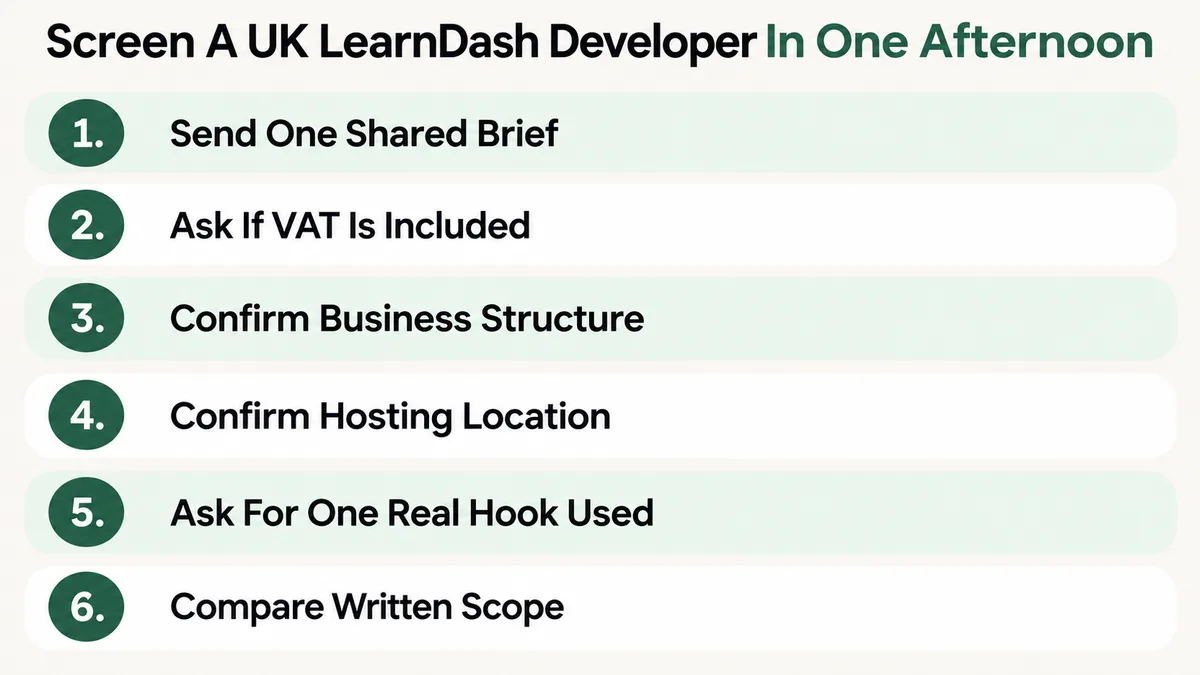
Run this order and you will cut a long shortlist down fast, because the UK-specific questions eliminate candidates just as quickly as the technical ones do.
- Send the identical one-page brief to every candidate, including your real data sensitivity level and your business structure.
- Ask whether the quoted rate includes VAT, and get the answer in writing.
- Ask how they invoice, sole trader, limited company, or umbrella, since this decides whether IR35 is even relevant.
- Ask for the real, named hosting provider and server location for student data.
- Ask for one specific LearnDash hook or filter they have used and what it changed, the same technical screen that applies anywhere.
- Compare the candidates still standing on written scope, not the headline hourly number.
How Do I Avoid Getting the IR35 Call Wrong?
The single most common mistake is assuming IR35 is a one-time check done at the start of a contract and then forgotten. The real working relationship, not the wording of the contract, is what HMRC assesses if the question is ever raised. If you exercise day-to-day control over how and when the developer works, require them to work exclusively for you during the engagement, and never let them send a substitute, the relationship can look like disguised employment regardless of what the paperwork says.
Three habits keep the determination defensible if it is ever questioned later. First, run the CEST tool at the start of the engagement and again if the scope changes meaningfully, since a status determination is tied to the specific working arrangement, not the developer generally. Second, let the developer genuinely control their own working hours and methods rather than directing their day the way you would an employee. Third, keep the written result alongside your contract, not just in an email thread that gets buried.
None of this applies if you are a sole trader rather than a limited company, or if the developer invoices you directly as an individual rather than through their own limited company. In those cases, confirm your actual status with an accountant rather than relying on a general article, since IR35’s specific mechanics only bite in a narrower set of structures than most people assume.
Do this: Re-run the CEST assessment if the scope of the engagement changes significantly, not just once at the start, and keep every result on file with the contract.
Frequently Asked Questions
How much does a LearnDash developer cost in the UK?
Roughly £25 to £40 per hour for an intermediate freelancer, £40 to £80 per hour for an experienced specialist, and £100 to £150 or more per hour for a premium specialist or agency. Fixed-price builds run £1,500 to £3,000 for a basic site and £5,000 to £15,000 or more for a custom build with compliance work included.
Do I have to pay VAT when I hire a LearnDash developer?
Only if the developer is VAT-registered, which only becomes mandatory once their taxable turnover crosses £90,000 in a rolling 12-month period as of the 2026/27 threshold. Many smaller freelance LearnDash developers are below that threshold and will not charge VAT. Always ask directly and get the answer in writing before comparing quotes.
Does IR35 apply if I hire a freelance LearnDash developer through my limited company?
It can, if the developer also operates through their own UK limited company rather than invoicing as a sole trader. From 6 April 2026, small companies under the new £15 million turnover threshold leave the self-assessment responsibility with the contractor’s own company rather than the hiring business, but running HMRC’s CEST tool and keeping the result on file is worth doing regardless of who is technically responsible.
Does my student data have to stay on UK servers under UK GDPR?
No. UK GDPR has no blanket data residency requirement. It requires that any transfer of personal data outside the UK uses a lawful transfer mechanism, and since 5 February 2026 that assessment runs against a new “not materially lower” protection test introduced by the Data (Use and Access) Act 2025. Many UK course businesses still choose UK or EEA hosting anyway simply to avoid running that assessment at all.
Is it better to hire a UK-based LearnDash developer or someone offshore?
A UK-based developer costs more but removes the time zone gap and generally already understands IR35 and UK GDPR without being walked through it. An offshore developer with strong LearnDash experience works fine for a straightforward build with no sensitive data involved. The premium earns its keep most clearly on a project touching regulated or sensitive student information.
What is the fastest way to spot a UK LearnDash developer who hasn’t thought about compliance?
Ask two questions. Whether their quote includes VAT, and where your students’ data will physically be hosted. A developer who has genuinely worked with UK clients before answers both immediately and specifically. Vague or surprised answers to either question are a reliable sign the compliance side of the engagement has not been considered yet.
I built Certified Boater, a NASBLA-approved boater safety course on LearnDash with quizzes, certificates, and a WooCommerce checkout that reached £14k in its first launch, and the compliance groundwork, confirming where student records lived and getting the data-handling terms written down before launch, mattered just as much to that result as the technical build itself. If you are also weighing whether LearnDash is still the right platform to build on given the ownership changes at StellarWP this year, that is a separate question worth answering first.
Need a LearnDash developer who already understands UK compliance?
Send me your brief, your current quotes, and where you plan to host student data. I will tell you honestly what is missing and what a fair UK quote looks like.