
Every time a client asks me how much does a ClickFunnels developer cost, I give them the same answer I am about to give you: it depends entirely on which of four different jobs you actually need. ClickFunnels sells itself as a drag-and-drop builder anyone can run without touching code, and for a single opt-in page that is genuinely true. The moment you want custom logic, a real integration, or a Classic-to-2.0 migration, the price stops being one number and turns into a range wide enough to hide a bad hire inside it.
I have quoted this kind of work myself, and I have been brought in after someone else quoted it badly. Below is the real spread of rates in 2026, what actually moves a quote up or down, and the costs that sit under a ClickFunnels project without ever showing up on the invoice.
Quick Answer
A ClickFunnels developer costs roughly $20 to $40 per hour for page setup and content entry, $25 to $75 per hour for an experienced freelancer handling custom elements and integrations, and $60 to $100 or more per hour through a vetted marketplace such as Arc. Fixed-price work usually runs $500 to $1,500 for a single styled funnel, and $2,500 to $8,000 for a full multi-funnel system with automations. A Classic-to-2.0 migration adds $1,500 to $6,000 or more on top, because there is no official bulk migration tool, only a page-by-page importer. Remember the platform itself is separate: ClickFunnels 2.0 runs $81 to $297 a month depending on tier, and the top Dominate tier is not even sold monthly.
📋 What’s Covered
02How Much Does a ClickFunnels Developer Cost per Hour in 2026?
03What Do Common ClickFunnels Projects Cost as a Fixed Price?
04How Much Does ClickFunnels Itself Cost on Top of the Developer?
05Why Does Classic vs 2.0 Decide What a Developer Can Even Migrate?
06What Makes One ClickFunnels Quote Triple Another?
07What Are the Hidden Costs Nobody Puts in the Quote?
08Where Do You Actually Find a Vetted ClickFunnels Developer?
09How Do You Check a ClickFunnels Developer Is Worth Their Rate?
10Why Is the Cheapest ClickFunnels Developer Usually the Most Expensive?
11How Do You Keep ClickFunnels Development Costs Down Long Term?
12Frequently Asked Questions
What Does a ClickFunnels Developer Actually Do If the Builder Is Drag-and-Drop?
This is the question most buyers ask first, and it is a fair one. ClickFunnels markets itself on the idea that you drag in a template, type your own words over it, and launch. For a plain opt-in page, that is accurate. So why would anyone pay a developer at all?
Because the drag-and-drop promise covers the default path, not every path. The work people actually hire for splits into four groups, and each one prices differently.
Page setup and content entry: building funnel steps from a template, loading copy and images, wiring the order form to a product and a thank-you page. No code involved. This is careful admin work, and it is the cheapest band.
Custom elements and design: HTML, CSS, and JavaScript blocks for layouts the native elements cannot produce, countdown logic, or a page that does not look like every other ClickFunnels page in your niche.
Integrations and automation: connecting ClickFunnels to a CRM, an email or SMS tool, a membership area, or GoHighLevel through its API, Zapier, or a direct webhook, and making sure a failed step does not silently drop a lead.
Migration: moving funnels from ClickFunnels Classic into 2.0, or bringing an audience and purchase history in from a different platform entirely. The most expensive category, and the one most often underquoted, for reasons covered further down this page.
Anyone who hands you a single hourly number without asking which of those four you need is guessing. The gap between the first group and the fourth is not a small premium. It is a different job with a different risk profile.
How Much Does a ClickFunnels Developer Cost per Hour in 2026?
Hourly rates cluster into four honest bands. Experience moves the number more than location does, though location still plays a real part.
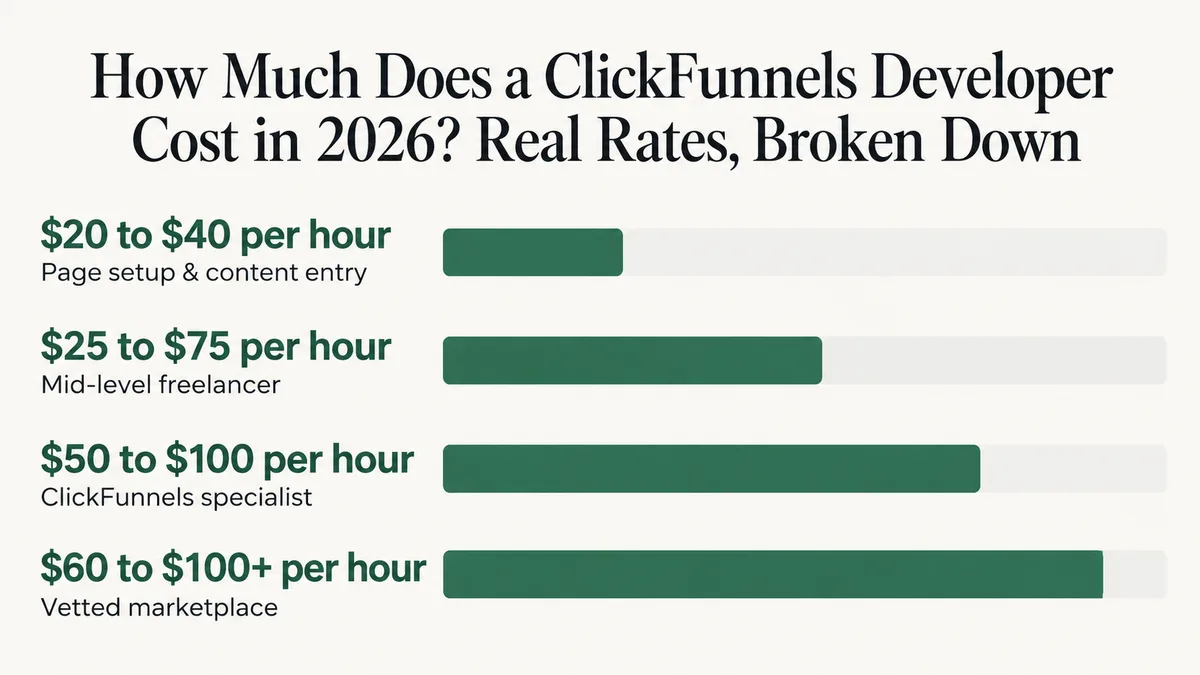
$20 to $40 per hour: page setup, content entry, and basic order form wiring, typically from freelancers in South Asia and Southeast Asia. Fine for loading a funnel you have already planned. Not the person to design your offer sequence or touch Payments AI configuration.
$25 to $75 per hour: Upwork’s own published rate guide puts intermediate professionals in most marketing-automation categories at $25 to $75 per hour, with specialised builds reaching higher. This band covers most mid-level ClickFunnels freelancers doing real custom work, not just template entry.
$50 to $100 per hour: specialists listed on freelancer platforms built around ClickFunnels work specifically, such as Contra’s dedicated ClickFunnels hiring page, where rates are quoted hourly, per project, or per milestone depending on the freelancer.
$60 to $100 and above per hour: vetted marketplace talent. Arc’s own ClickFunnels hiring page states its freelance ClickFunnels developers typically charge between $60 and $100 or more per hour. Arc also quotes full-time-equivalent rates around $70 to $100 per hour for United States-based developers, which is a different purchase than a short freelance engagement.
One figure that deserves context before you panic over it: GrowthMentor lists ClickFunnels mentoring rates at $100 to $200 per hour. Those are consulting calls about funnel strategy and conversion, not someone building your pages. If a quote lands in that range for hands-on build work, ask exactly what portion of the hour is strategy versus construction.
What Do Common ClickFunnels Projects Cost as a Fixed Price?
Most ClickFunnels work is sold as a project rather than by the hour, so treat the bands above mainly as a sanity check on the total. Here is the realistic shape of fixed-price quotes I see repeat across real projects.
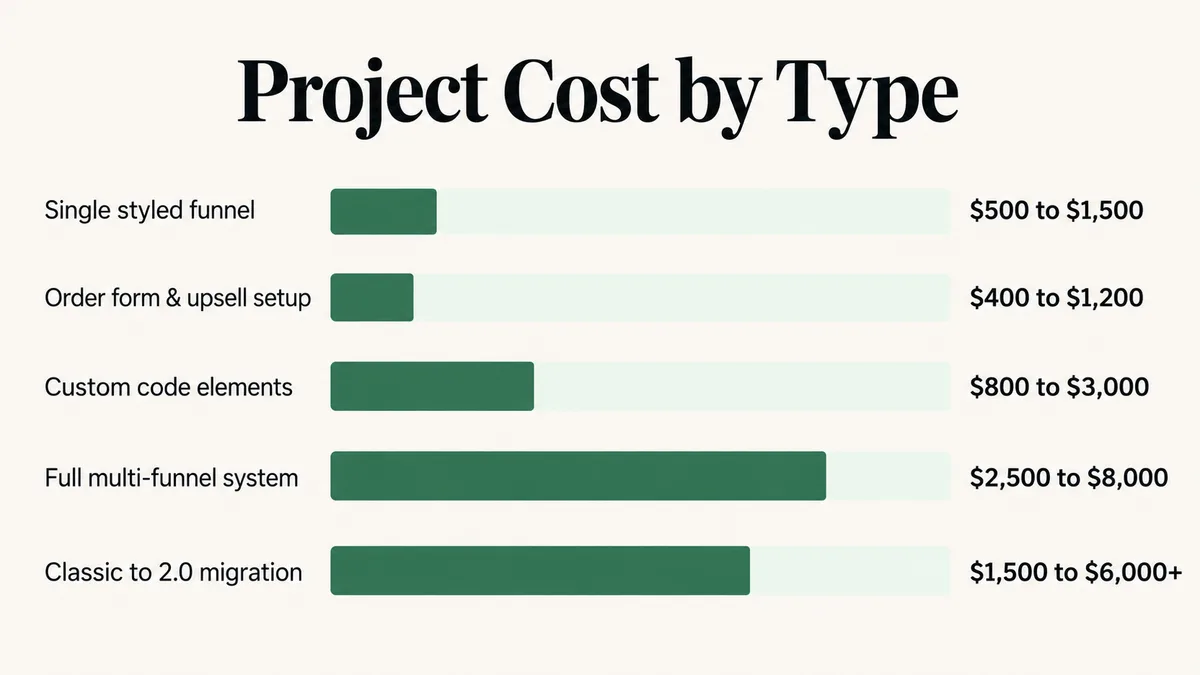
- Single sales funnel, styled: $500 to $1,500. One opt-in or sales page, one order form, one thank-you page, brand applied properly, no custom code.
- Order form and upsell path setup: $400 to $1,200. Products attached correctly, one-click upsells configured, decline handling checked against real test cards.
- Custom HTML, CSS, or JavaScript elements: $800 to $3,000. This is where the native builder stops and real front-end code starts.
- Full multi-funnel system with automations: $2,500 to $8,000. Several funnels, CRM or email integration, workspace structure, and testing across the whole buyer journey.
- Classic-to-2.0 migration: $1,500 to $6,000 or more, and highly variable, since there is no bulk migration tool. Moving one page is quick. Moving a dozen funnels with products, upsells, and custom elements intact is not.
Ongoing retainers for new launches, small edits, and monitoring usually run $500 to $2,000 per month. That tends to beat paying hourly for scattered requests, as long as the retainer states exactly what it covers.
Treat every number above as a starting shape, not a promise. The real variance inside each range comes from the cost drivers further down this page, not from negotiation.
How Much Does ClickFunnels Itself Cost on Top of the Developer?
A developer’s quote almost never includes the platform. Straight from ClickFunnels’ own pricing page, the current ClickFunnels 2.0 plans, billed monthly, are:
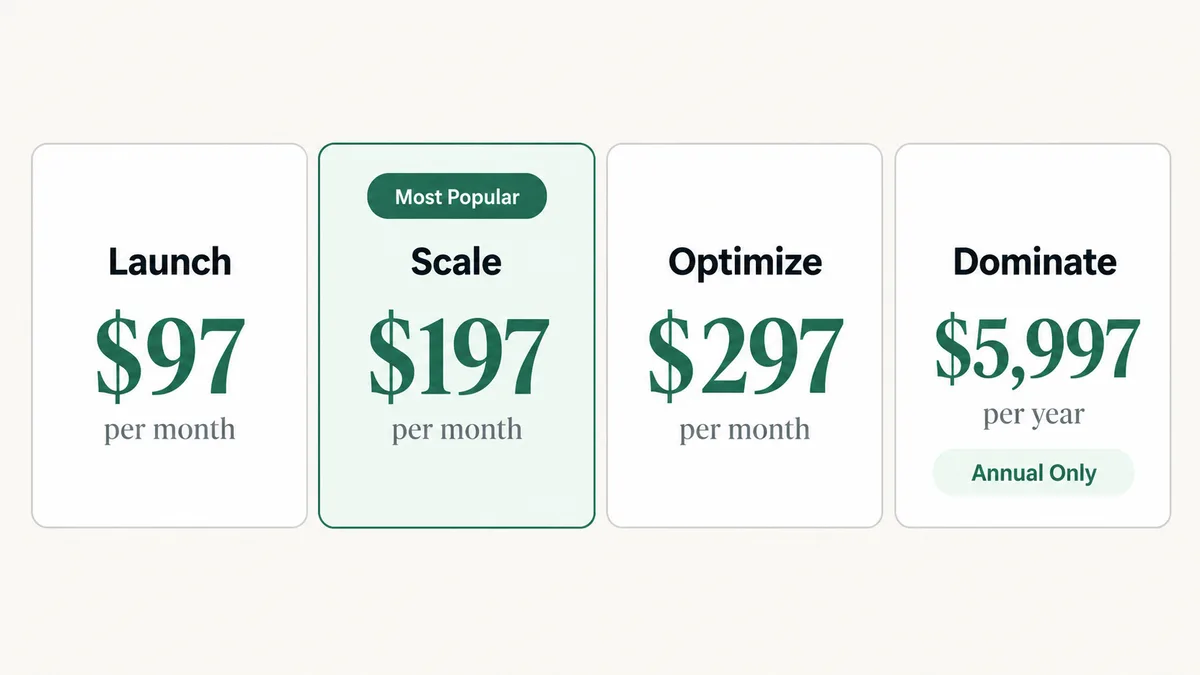
- Launch: $97 per month, or $81 per month billed annually. 1 workspace, 2 team members, 10,000 contacts, 5 custom domains.
- Scale: $197 per month, or $164 per month billed annually. 5 workspaces, 5 team members, 75,000 contacts, unlimited custom domains. ClickFunnels markets this as its most popular tier.
- Optimize: $297 per month, or $248 per month billed annually. 10 workspaces, 10 team members, 150,000 contacts.
- Dominate: $5,997 per year, annual billing only. There is no monthly option on this tier at all. 20 workspaces, 20 team members, 400,000 contacts, and 3 hours of private onboarding included.
Payment processing sits on top of that, and this is where the sources genuinely disagree, so I will give you both sides rather than pick one for you. ClickFunnels’ own support documentation states plainly that it does not charge any fees for processing payments beyond the gateway’s own rate, which is 2.9% plus $0.30 per transaction on its native Payments AI.
Several independent reviews, and a comment thread on ClickFunnels’ own public feedback board, describe a separate 1% surcharge when you route your own Stripe account through Payments AI instead of using Payments AI directly. Both cannot be fully true at once. Ask ClickFunnels support to confirm in writing which applies to your specific account before you build a margin calculation around either figure.
So the honest first-year picture for a custom build is the developer fee plus somewhere between roughly $972 and $3,564 of platform subscription on Launch through Optimize, before transaction fees and before any external tools. If a funnel’s projected revenue cannot comfortably absorb that floor, it is worth confirming ClickFunnels is the right platform before anyone starts building on it.
Why Does Classic vs 2.0 Decide What a Developer Can Even Migrate?
Here is the structural fact that surprises almost every buyer, and it changes a quote more than any negotiation will.
ClickFunnels Classic and ClickFunnels 2.0 are not versions of one product. ClickFunnels’ own upgrade FAQ describes 2.0 as an entirely new platform built from the ground up, and it states clearly that signing up for 2.0 does not create or copy your Classic account. There is no automatic migration path. Your Classic funnels stay exactly where they are until someone moves them, page by page.
That manual move runs through a tool called BarnumPT, and ClickFunnels’ own documentation is specific about what it does not do. BarnumPT imports individual pages, not whole funnels, so each page in a funnel has to be migrated on its own. Products are not included and must be reattached manually.
Certain elements, such as Social Share and Survey blocks, do not always import cleanly, and ClickFunnels states outright that it cannot guarantee full compatibility of content, layout structure, colors, fonts, or mobile optimization on anything that does transfer.
Timing matters here in a way most buyers never check. ClickFunnels updated its own support documentation in January 2026 to confirm that Maintenance Mode, the setting that lets a connected Classic and 2.0 account bill you for 2.0 only, is no longer available if you created your 2.0 account after January 18th, 2026. Existing users who already had that connection keep it. Anyone signing up fresh after that date pays both subscriptions in full while the migration happens, which is a real monthly cost a developer’s quote will not mention unless you ask.
Do this: Tell every candidate your account’s exact creation date and whether Maintenance Mode applies to you, and ask them to confirm in writing which pages need a true rebuild versus a BarnumPT copy. A specialist who has actually run this migration answers both questions immediately.
What Makes One ClickFunnels Quote Triple Another?
When two quotes for what sounds like the same project differ by a factor of three, one of these six things is almost always the real reason.
- Who writes the offer copy. A developer builds the funnel structure. Someone still has to write the headline, the bullet points, and the order form copy that actually sells. If nobody named an owner for that, it becomes an extra line item or a delay.
- Native elements versus custom code. A configured template and a genuinely custom page are separated by real HTML, CSS, and JavaScript work, which is a different skill than drag-and-drop assembly.
- Number of integrations. Each connected tool, a CRM, an email platform, SMS, GoHighLevel, is its own small project: mapping fields, handling a failed webhook, and testing the case where payment succeeds but the automation does not fire.
- Migration scope. One Classic funnel moved to 2.0 is an afternoon. Twelve funnels with products, upsells, and custom elements is a multi-week project, and it is the detail most buyers forget to mention when asking for a quote.
- Number of offers and upsell paths. One product with one price point is a fraction of the work of a full value ladder with order bumps, one-click upsells, and downsells.
- Revision rounds. Two included rounds versus unlimited revisions is a real cost difference, and the vaguer quote is usually the one that turns into a dispute later.
Send every candidate the same one-page brief covering those six points. Quotes only become comparable once the inputs are identical, and how someone responds to a real brief tells you more than a sales call ever will.
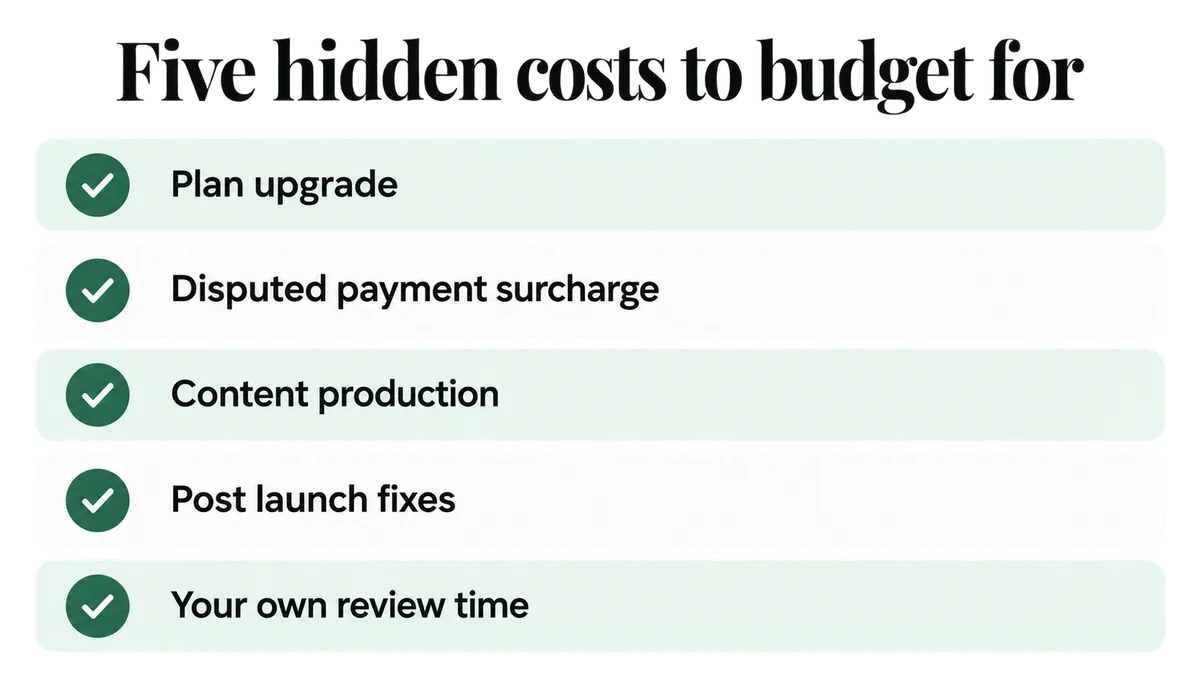
What Are the Hidden Costs Nobody Puts in the Quote?
These are the line items that catch people repeatedly, and almost none of them appear on a typical proposal.
- The plan upgrade. Outgrowing Launch’s single workspace and 10,000 contacts means moving to Scale at $164 to $197 per month, a real recurring jump most buyers do not budget for upfront.
- The disputed payment surcharge. If you bring your own Stripe account instead of using Payments AI directly, confirm in writing whether the 1% surcharge several independent sources describe actually applies to you, since ClickFunnels’ own documentation and those reports disagree.
- Content production. Offer copy, product photography, and video are separate crafts. A developer quoting “a full funnel” rarely includes any of them.
- Post-launch fixes. Real buyers find edge cases a test account never hits. I have written separately about the specific symptoms behind a ClickFunnels order form that stops submitting, and almost every cause on that list shows up after launch, not during testing.
- Your own review time. The most underestimated cost of all. Approving pages, gathering assets, and answering questions is real work, and a project stalls on your inbox as easily as on the developer’s.
None of these make the project a bad idea. They belong in the budget conversation at the start, not as a surprise in week four.
Where Do You Actually Find a Vetted ClickFunnels Developer?
I looked for an official ClickFunnels-run certified partner directory while writing this, the way Kajabi and some other platforms run one. I could not find one. What exists instead is a scattered set of third-party marketplaces, each with its own vetting standard or lack of one.
Arc.dev runs a dedicated ClickFunnels hiring page with its own vetting process and the $60 to $100-plus hourly range quoted earlier. Contra lists individual ClickFunnels freelancers who set their own hourly, project, or milestone rates with no platform-wide vetting standard behind them. GrowthMentor is useful for strategy and mentoring, not hands-on builds. General marketplaces, Upwork and Fiverr among them, carry the widest range of quality and price for exactly that reason, nothing stops a $15 an hour profile from describing itself as an expert.
A handful of regional reseller directories exist too, Elioplus runs one for Canada, for example, but these are vendor-run listings of resellers and training partners, not an independent quality guarantee. Because none of these carry ClickFunnels’ own vetting, the checks in the next section are doing the work an official directory would otherwise do for you.
How Do You Check a ClickFunnels Developer Is Worth Their Rate?
Run these in order. It takes an afternoon and removes most of the risk in the decision.
- Ask for three live ClickFunnels URLs, not screenshots, and open each one yourself on a phone and a desktop.
- Ask whether each example was built on Classic or 2.0. Someone who has only ever worked in Classic has never touched the 2.0 builder’s actual limitations.
- Ask what the hardest problem on one of those builds was. A real answer is specific and slightly unglamorous, like an order form that silently failed on a specific card type, or an upsell that charged twice.
- If migration is involved, ask them to walk you through what BarnumPT does and does not carry over. Vague answers here mean they have not actually run a Classic-to-2.0 migration.
- Ask what is included after launch, for how long, and at what rate afterward.
- Pay for a small trial task first. Two to four hours of real work on one page reveals more than any interview will.
On the live-URL check specifically, insist on the same specificity you would want from anyone claiming experience. Vague claims about “dozens of funnels built” without a single one you can open yourself are the fastest disqualifier there is.
Why Is the Cheapest ClickFunnels Developer Usually the Most Expensive?
The $15 an hour quote is real, and it is genuinely the wrong purchase for anything past basic content entry. The reason is structural, not a judgment about anyone’s skill.
A funnel holds live commercial state the moment it goes live: which order form maps to which product, which upsell fires after which purchase, which webhook feeds your CRM or your affiliate tracking. A cheap build usually still looks correct on the surface. What it quietly gets wrong is the relationships underneath, and those relationships only surface as problems once real paying customers are sitting inside them.
Fixing that afterward costs more than building it correctly once, for a reason that has nothing to do with hourly rates. A second developer first has to understand every decision the first one made before they can safely undo it, and by then there are live transactions and active customers attached to the old structure. You cannot simply delete and rebuild once money is already moving through it.
The second structural cost is undocumented custom code. Injected HTML, CSS, and JavaScript live inside your funnel with no version history and no comments explaining why they exist. When the person who wrote it is gone, the next developer’s first invoice is for reading and reverse-engineering, not for building anything new.
How Do You Keep ClickFunnels Development Costs Down Long Term?
Four habits keep this budget predictable, and none of them involve negotiating a rate down.
First, launch one funnel that genuinely works before building five that half work. A smaller first engagement also gives you a real working relationship with a developer to expand later, instead of a large bet placed on a stranger. The first round of inevitable fixes is cheap when the scope was small to begin with.
Second, use ClickFunnels’ native elements wherever a native element is genuinely good enough. Every piece of custom code is a permanent maintenance liability that outlives the person who wrote it. Custom work on the pages that actually sell, standard configuration everywhere else, is the arrangement that ages well.
Third, keep your own record of what was built: which funnel maps to which product, which automations exist and what triggers them, and where any custom code sits. A single shared document maintained during the build costs nothing and saves days of reverse engineering later.
Fourth, own every account yourself. Your ClickFunnels subscription, your payment gateway, your domain registrar, and any connected automation tool should all be registered to you, not to your developer. This is not about distrust. It is about not being locked out of your own business if the relationship ends.
Do this: Require a written scope with deliverables, a named owner for copy and creative, a fixed number of revision rounds, and explicit confirmation that every account and subscription is registered in your name.
Frequently Asked Questions
Do I need a ClickFunnels developer at all, or can I build it myself?
If you want a single, straightforward funnel using ClickFunnels’ own templates and Payments AI checkout, plenty of people build that themselves. Hire someone when you want custom code the templates cannot produce, a real integration with an outside system, a Classic-to-2.0 migration, or simply your own time back. Those four reasons cover almost every legitimate ClickFunnels hire.
Is a ClickFunnels developer cheaper than a Kajabi or LearnDash developer?
The hourly bands are similar across all three, roughly $20 to $100-plus depending on experience. The real cost difference is in the platform subscription and scope: ClickFunnels is built purely for funnels, while Kajabi and LearnDash also carry course and membership infrastructure. I covered the Kajabi side of this in detail in how much a Kajabi developer actually costs, and the same logic of hourly band plus hidden platform costs applies here too.
Should I migrate from ClickFunnels Classic to 2.0, and does that need a developer?
ClickFunnels does not require Classic users to move to 2.0, and your Classic account keeps working exactly as it always has if you stay put. If you do move, a developer is worth it the moment you have more than a couple of funnels, since the official BarnumPT tool only copies individual pages, not whole funnels, and products have to be reattached by hand.
How long should a ClickFunnels build take?
A single styled funnel is a few days of real work. A full multi-funnel system with integrations typically runs two to four weeks. A Classic-to-2.0 migration depends entirely on how many funnels and products exist, and content preparation, not development, is almost always the real bottleneck.
Should I pay hourly or a fixed price?
Fixed price works once the scope is genuinely written down, which is why the one-page brief matters. Hourly suits ongoing changes and unclear scope better. A common, healthy arrangement is a fixed price for the defined build, milestone payments against real deliverables, and an hourly rate for anything added afterward.
Where do I find a ClickFunnels developer now?
There is no official ClickFunnels-run certified partner directory as of this writing. Arc.dev runs a dedicated ClickFunnels hiring page with its own vetting, Contra lists individual freelancers who set their own rates, and general marketplaces such as Upwork and Fiverr carry the widest range of price and quality. Because none of these carry a platform-run vetting standard, the verification steps earlier in this article are doing that job for you.
Not sure whether your quote is fair?
Send me the brief and the numbers you have been given. I will tell you honestly what is missing from the scope and whether the price matches the work, whether or not you end up hiring me.
Or have it built properly the first time
Funnels, order forms, upsell paths, integrations, and Classic-to-2.0 migrations, quoted against a written scope with no plan-upgrade surprises halfway through.