

A client emailed me in a panic last week after reading a blog post calling LearnDash “collapsed.” He has a six-figure course business built on it and wanted to know one thing: is LearnDash still safe, or does he need to migrate immediately? I get versions of this question often enough now that it is worth answering in public rather than one inbox at a time. StellarWP, the company that owned LearnDash, really did fall apart in 2026, and the panic is understandable. But “StellarWP collapsed” and “LearnDash is dying” are two different claims, and only one of them is actually true.
I build on LearnDash for a living, so I have a direct stake in getting this right rather than either dismissing the real risk or exaggerating it for clicks. Here is what actually happened, what genuinely changed, and the specific things worth checking on your own site this week.
Quick Answer
Is LearnDash still safe to build on? Yes. Liquid Web officially dissolved the StellarWP brand on April 22, 2026, folding roughly ten products into four it plans to keep investing in, and LearnDash is one of those four survivors, not one of the casualties. What genuinely changed is the team behind it, not the product itself.
LearnDash’s own Product Owner was laid off in late 2025, and nearly the entire StellarWP leadership team quit during 2025 over disagreements with new ownership. The plugin itself still ships, still gets security patches committed through April 2027, and still powers real, actively growing course businesses. The honest caution is that it now reads as a maintenance-mode product rather than one in an active growth phase, which matters for planning but is not the same thing as being discontinued.
📋 What’s Covered
02Is LearnDash Still Safe, or Is It Being Discontinued?
03Why Did Nearly Everyone Leave, and Does It Actually Affect Your Site?
04What Happens to Your License, Support, and Renewals Now?
05Risk 1: Are You Relying on an Add-On That Got Folded Into LearnDash?
06Risk 2: Has Feature Development Actually Slowed Down?
07Risk 3: Is Support Quality Changing Under a Smaller Team?
08Risk 4: Could Pricing or Licensing Change Later Under Liquid Web?
09Risk 5: Is Any Other Part of Your Stack Tied to a Retired StellarWP Brand?
10How Do You Audit Your Own LearnDash Site for These Risks This Week?
11Should You Migrate Off LearnDash, or Just Watch and Wait?
12Frequently Asked Questions
What Actually Happened to StellarWP?
StellarWP was the umbrella company that spent years buying up well-known WordPress plugins and folding them under one roof: LearnDash, GiveWP, KadenceWP, SolidWP, Restrict Content Pro, MemberDash, Iconic, and The Events Calendar, among others. On April 22, 2026, its parent, Liquid Web, officially announced that the StellarWP brand was being dissolved entirely, with the whole portfolio rebranded and consolidated under “Liquid Web by Nexcess,” a change covered in detail by WPBeginner as it happened.
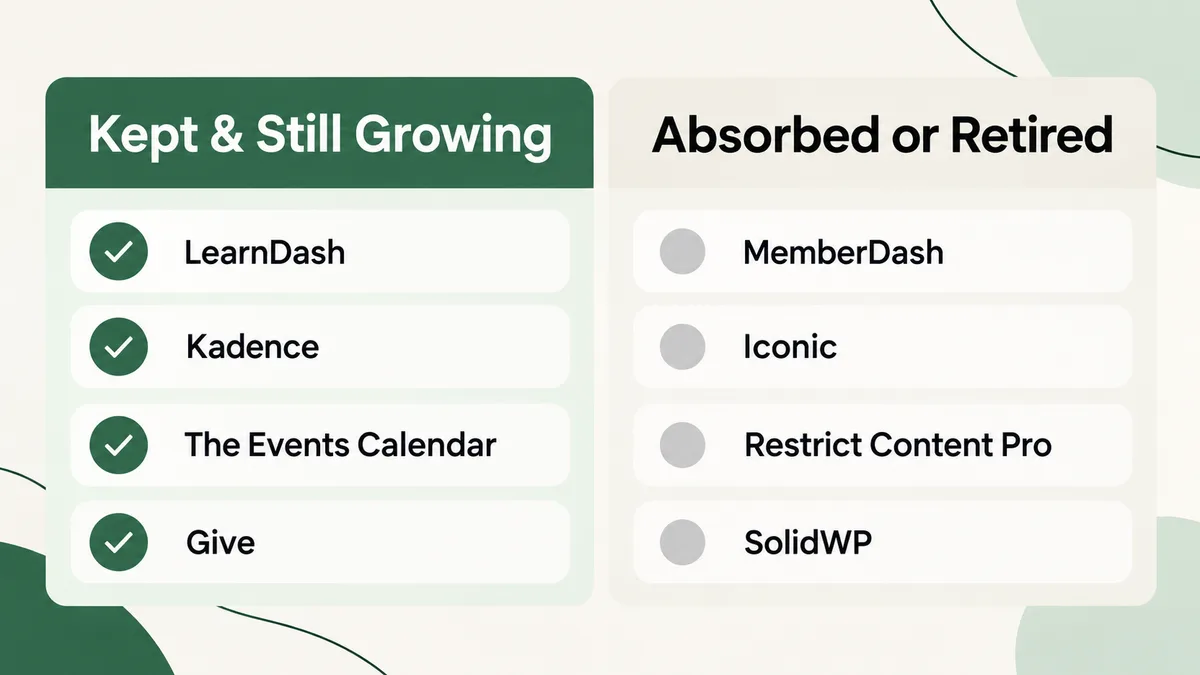
Out of roughly ten products StellarWP had accumulated, Liquid Web named exactly four it intends to keep actively investing in: LearnDash, Kadence, The Events Calendar, and Give. Everything else, including MemberDash, Iconic, Restrict Content Pro, and SolidWP, was either folded into one of the survivors or moved to a reduced maintenance track. That distinction, four kept versus the rest absorbed or wound down, is the single most important fact in this entire story, and it is the one that gets flattened into “StellarWP collapsed” headlines without the nuance of who actually survived.
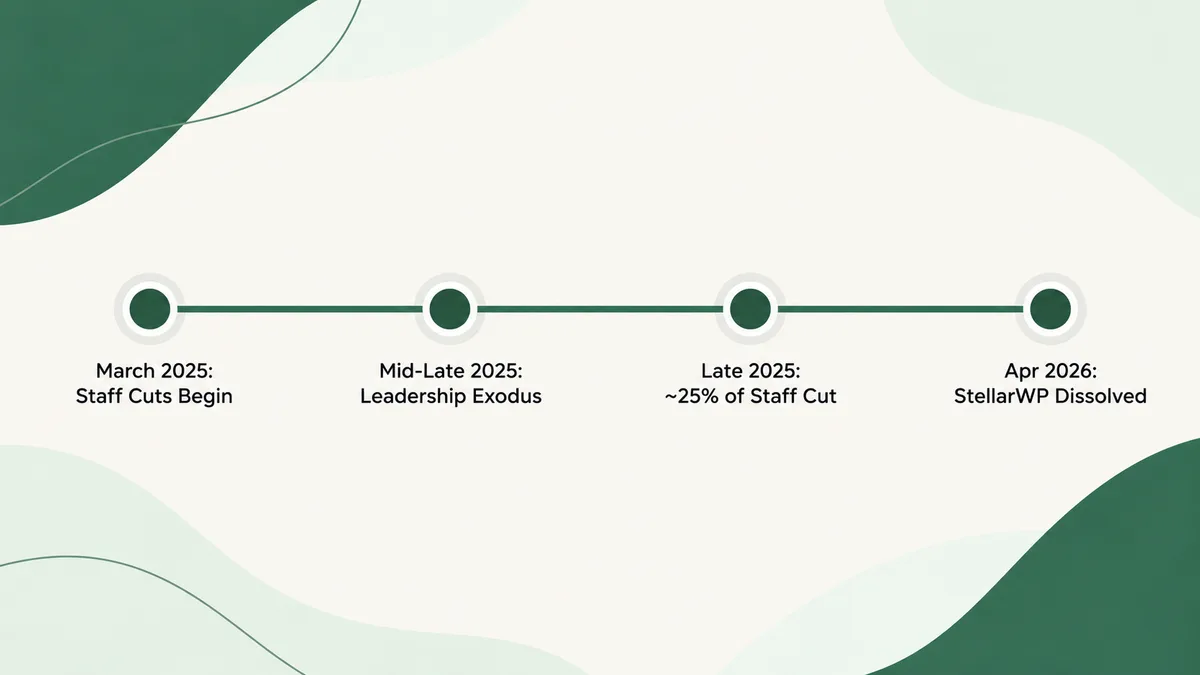
The dissolution did not happen in isolation. Nexcess, Liquid Web’s own managed WordPress hosting brand with more than two decades of history, was fully absorbed into Liquid Web in October 2025 and lost its independent identity in the same consolidation wave. Two rounds of layoffs preceded the announcement: a 5 percent cut in March 2025, concentrated in development and marketing, followed by a deeper cut of roughly 36 people, about a quarter of the remaining staff, in late 2025. Whatever reorganization was happening internally at Liquid Web, it was clearly underway for most of a year before the public announcement caught up with it.
Is LearnDash Still Safe, or Is It Being Discontinued?
No, and this is worth stating plainly because it is the single most searched version of this question and the easiest one to get a straight answer to. LearnDash was explicitly named as one of the four products Liquid Web intends to keep investing in, not one of the ones being retired or absorbed. The plugin still ships new releases, still receives updates, and Liquid Web has committed to critical security patches through April 2027 at minimum for the brands that came out of this consolidation.
I have a LearnDash build in production right now for Certified Boater, a NASBLA-approved boater safety course with quizzes, certificates, and WooCommerce checkout that has generated real revenue since launch, and nothing about the StellarWP news has changed how that site runs or what I would recommend to a new client starting a similar build today. You can see that project and others on the live portfolio page. Real businesses are not pausing their LearnDash builds over this, because the plugin itself did not stop working the day the announcement went out.
The honest nuance, and the reason this question keeps coming up despite a clear answer, is that “not discontinued” is not the same as “business as usual.” Several credible industry writeups describe LearnDash post-consolidation as reading like a maintenance-mode product: still supported, still patched, but with the pace of new feature development visibly slower than during its independent-brand years. That distinction matters for anyone planning a multi-year course business, which is exactly what the risk signals further down this guide are built to help you evaluate for your own situation.
Why Did Nearly Everyone Leave, and Does It Actually Affect Your Site?
This is the part of the story that genuinely is dramatic, and it is worth naming specifically rather than vaguely, because vague “there was some turnover” framing understates what actually happened. Taylor Walden, LearnDash’s own Product Owner, was among the roughly 36 people laid off in the late-2025 cuts. Benjamin Ritner, the founder of KadenceWP, left in late 2025.
Matt Cromwell, co-founder of GiveWP, gave notice around the same time, and later said publicly that “every single person on the StellarWP leadership team quit in 2025,” attributing it to new leadership under CloudOne Digital having a vision the existing team disagreed with. Devin Walker, GiveWP’s other co-founder, left Liquid Web in August 2025 and now leads Jetpack at Automattic.
Walker’s own farewell post is worth reading directly rather than taking secondhand, because it is measured rather than alarmist: he describes the departure as personal timing more than a crisis, and says plainly that he believes “GiveWP is in good hands” going forward. That is a useful data point. The people leaving were not uniformly warning customers to flee; several described it as an organizational and leadership disagreement, not a verdict on whether the products themselves still work.
Does it affect your site directly? Not through any mechanism that touches how LearnDash runs today. A Product Owner leaving changes who makes roadmap decisions and how fast new features ship, which is a real, legitimate long-term planning concern. It does not reach into your installed plugin and change how your quizzes grade, how your certificates generate, or how your students log in. Code that already shipped keeps running regardless of who is on the team the day after a departure.
What this means for you: Treat the leadership exodus as a signal to watch the pace of future releases, not as a reason to panic about your site’s current stability. Those are two different timelines.
What Happens to Your License, Support, and Renewals Now?
If you are already running LearnDash, the practical mechanics of ownership stay the same in the near term: your license keeps working, renewals process the same way, and support tickets still get answered, just by a smaller team operating directly under Liquid Web rather than under the standalone StellarWP identity.
The one place real consumers of absorbed products need to watch closely is anything that got folded into LearnDash rather than kept as its own line, MemberDash specifically. Existing MemberDash subscriptions stay active for as long as renewal payments continue, but if a subscription lapses, the replacement is one of the new consolidated software plans rather than a like-for-like MemberDash renewal.
That one detail is worth sitting with, because it is the most concrete near-term action item in this entire story for a specific subset of readers. If you built any part of your membership logic on MemberDash rather than on LearnDash’s own native membership features, check your renewal date now rather than finding out what changed at the moment it lapses.
Risk 1: Are You Relying on an Add-On That Got Folded Into LearnDash?
Check which StellarWP-owned add-ons your specific build actually uses, not just the core LearnDash plugin. MemberDash is the clearest case already covered above, but the broader principle applies to any smaller StellarWP product you layered on top of LearnDash for a specific feature, since those are exactly the products most likely to have been absorbed rather than kept as an independent line.
What this means for you: List every StellarWP-owned plugin active on your site, not just LearnDash itself, and check each one’s current status individually. A bundled add-on can be quietly discontinued while the core product you think of as “LearnDash” stays completely fine.
Risk 2: Has Feature Development Actually Slowed Down?
This is the real, measurable version of the “maintenance mode” concern raised earlier, and it is checkable rather than a matter of opinion. Look at LearnDash’s own changelog and release history before and after the late-2025 layoffs. A pattern of smaller, less frequent releases heavy on compatibility and security fixes, with few genuinely new features, is consistent with a team that shrank doing exactly what a shrunk team would do: keep the lights on first.
What this means for you: If your business plan depends on a specific LearnDash feature that does not exist yet, do not assume it is coming soon. Build around what the plugin can do today, and treat any announced roadmap item as a bonus rather than a dependency.
Risk 3: Is Support Quality Changing Under a Smaller Team?
A team that lost roughly a quarter of its staff and its own product owner in a single round of cuts is, by definition, running with fewer people to answer the same volume of support tickets. That does not automatically mean support gets worse, since remaining staff can be reallocated and some absorbed brands bring their own support teams along, but it is a real operational strain worth testing rather than assuming away.
What this means for you: Open a real, non-urgent support ticket now, before you actually need a fast answer during a launch, and time how long a genuinely useful response takes. That single data point tells you more than any public statement will.
Risk 4: Could Pricing or Licensing Change Later Under Liquid Web?
Consolidations like this one frequently get followed, a year or two later, by pricing or licensing restructuring, once the new owner has finished the operational cleanup and turns to monetization. Nothing confirmed has been announced for LearnDash specifically at the time of writing, but the MemberDash precedent, where a lapsed subscription now converts into a different, newly consolidated plan rather than a renewal of the old product, is exactly the kind of structural change worth watching for across the rest of the LearnDash line too.
What this means for you: Lock in your current license term if a multi-year renewal option exists at today’s terms, and avoid assuming your current plan’s pricing structure is guaranteed to look the same at your next renewal date.
Risk 5: Is Any Other Part of Your Stack Tied to a Retired StellarWP Brand?
LearnDash rarely runs completely alone. Plenty of real course sites also use KadenceWP for the theme, GiveWP for donations alongside course sales, or Restrict Content Pro for a separate membership layer, and every one of those products went through the exact same consolidation LearnDash did, just without surviving as one of the four kept lines. A site can have a perfectly safe LearnDash core sitting on top of a theme or plugin from the same company that genuinely is winding down.
What this means for you: Audit every plugin and theme on your site, not just LearnDash, against the list of StellarWP brands. “My LMS is fine” and “my whole stack is fine” are not automatically the same statement.
How Do You Audit Your Own LearnDash Site for These Risks This Week?
Run these in order. Each one takes a few minutes and together they give you a real, specific answer instead of a feeling.
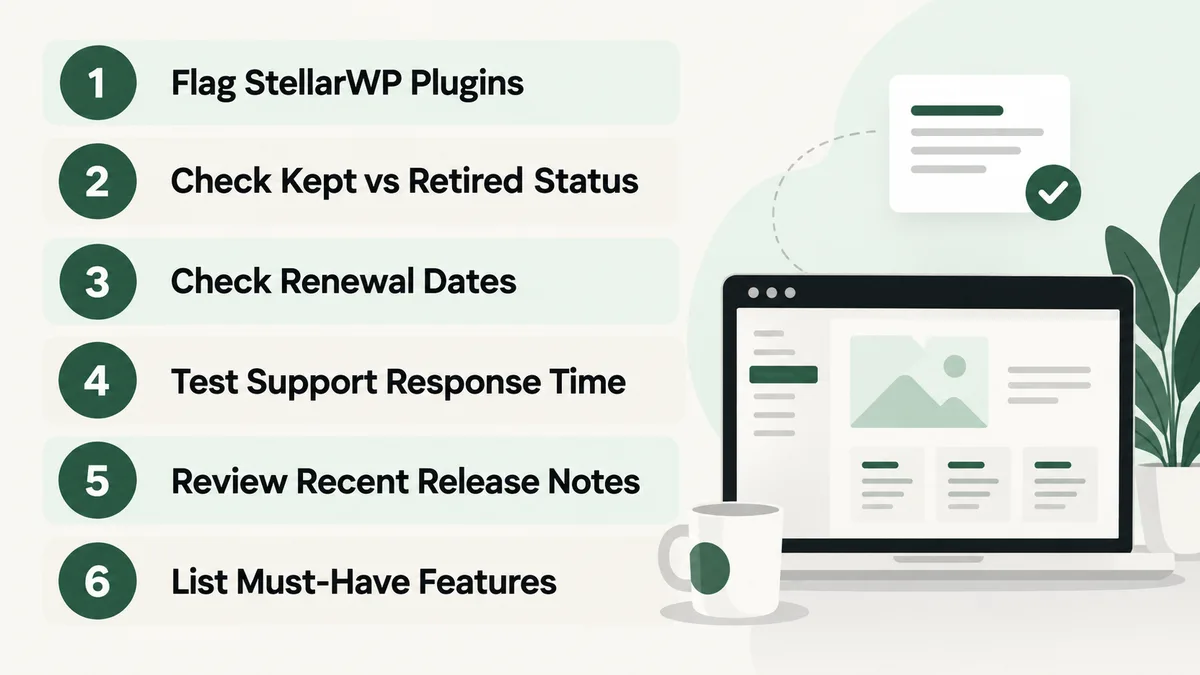
- Open your WordPress plugin list and flag every plugin and theme originally owned by StellarWP: LearnDash, MemberDash, KadenceWP, GiveWP, SolidWP, Restrict Content Pro, Iconic, and The Events Calendar.
- For each flagged item, check whether it was named as one of the four kept products (LearnDash, Kadence, The Events Calendar, Give) or was absorbed/retired, and look up its current renewal terms directly.
- Check your license renewal date for anything absorbed, MemberDash especially, and note what happens if it lapses before your next planned review.
- Open a real, non-urgent support ticket and time the response, as a live read on current support capacity.
- Review LearnDash’s last two to three release notes for the actual mix of security fixes versus new features, rather than assuming either one.
- Write down which specific features you are depending on that do not exist yet, and confirm none of your business plan assumes they are arriving soon.
Most sites that run this audit come out of it with zero urgent action items and a clearer sense of what to monitor. That outcome is worth having in writing rather than carrying a vague, unresolved worry indefinitely.
Should You Migrate Off LearnDash, or Just Watch and Wait?
For the overwhelming majority of existing LearnDash sites, the honest answer is watch and wait, not migrate. A platform being named one of four kept products with security patches committed through April 2027 is not a burning-building situation, and a migration carries its own real cost and risk, student data, quiz history, certificate records, and payment continuity all have to move cleanly, the exact concern covered in a separate guide on migrating onto LearnDash from Kajabi. Trading a manageable, watchable risk for the guaranteed disruption of a full migration rarely comes out ahead on its own merits.
Migration becomes the right call in a narrower set of cases: your business depends heavily on an add-on that was genuinely retired rather than absorbed, the audit above turns up a support response time that has visibly degraded over several real tickets, or your growth plan specifically requires a feature LearnDash’s current pace of development makes unlikely to arrive in your planning window.
If you are already weighing LearnDash against another platform for a new build rather than deciding whether to leave an existing one, the real differences between LearnDash and Kajabi are worth reading before this story factors into that decision at all, since most of what separates the two platforms has nothing to do with StellarWP.
If your own audit genuinely turns up a concrete red flag rather than a general unease, that is exactly the kind of specific, verifiable situation worth getting a second opinion on before committing to either path.
Frequently Asked Questions
Is LearnDash shutting down in 2026?
No. LearnDash was explicitly named one of the four products Liquid Web kept actively investing in after dissolving the StellarWP brand on April 22, 2026, alongside Kadence, The Events Calendar, and Give. It is not one of the products being retired or absorbed, and it continues to receive updates and security patches, committed through at least April 2027.
What is StellarWP and why did it fall apart?
StellarWP was the umbrella brand under which Liquid Web had consolidated LearnDash, GiveWP, KadenceWP, SolidWP, Restrict Content Pro, MemberDash, Iconic, and The Events Calendar. It fell apart through a combination of two rounds of layoffs during 2025, roughly 36 people let go in the largest cut, and a near-total exodus of its leadership team, who publicly cited disagreements with new ownership under CloudOne Digital. Liquid Web formally dissolved the brand in April 2026.
Should I still start a new course business on LearnDash right now?
Yes, with the same due diligence you would apply to any plugin from a company that just went through a visible leadership change. LearnDash remains one of the most mature, widely deployed course plugins for WordPress, it is one of Liquid Web’s four confirmed kept products, and real, currently profitable course businesses continue to launch on it. Avoid add-ons from retired StellarWP brands rather than LearnDash’s own native features, and you are starting from a stable base.
What happened to MemberDash specifically?
MemberDash was folded into LearnDash rather than kept as its own independent product line. Existing MemberDash subscriptions stay active for as long as renewal payments continue uninterrupted, but once a subscription lapses, the replacement is one of the newly consolidated software plans rather than a like-for-like MemberDash renewal. Anyone with membership logic built on MemberDash specifically should check their renewal date now.
Did LearnDash’s own Product Owner really get laid off?
Yes. Taylor Walden, LearnDash’s Product Owner, was among the roughly 36 people let go in the largest round of StellarWP layoffs in late 2025. That departure affects who makes near-term roadmap and feature decisions, which is a legitimate long-term planning concern, but it does not change how the already-shipped LearnDash plugin runs on an existing site.
How is this different from when other WordPress plugin companies have been acquired before?
The underlying pattern, an acquirer consolidating several brands and quietly retiring the weaker ones, is common across WordPress plugin history. What makes this case unusually well-documented is the combination of a public, named dissolution announcement, specific layoff numbers, and several departing leaders speaking on record about why they left, rather than the typical silent drift into inactivity most WordPress plugin sunsets follow.
Want a real second opinion on your own LearnDash site?
Send me your plugin list and I will tell you honestly which StellarWP-era dependencies, if any, are actually worth worrying about on your specific setup.