

Most people trying to figure out how to hire a Circle developer start by posting a job that actually describes two different roles at once. One role keeps a community active day to day: welcoming members, running events, moderating threads. The other role builds the thing underneath that: spaces architecture, paywalled access, workflow automation, API integrations. Hire the wrong one and you either overpay for daily moderation you did not need, or underpay a technical build and watch it fall apart the first time a real member tries to upgrade their membership or a Zapier automation misfires.
Circle markets itself as flexible enough that anyone can set it up without help, and for a single simple community with one space and no paywall, that is mostly true. The complexity shows up the moment you need tiered access, automated onboarding tied to a purchase, or a migration from another platform that has to preserve existing members. I have reviewed enough of these builds, both well done and rescued after a bad hire, to know exactly where this decision usually goes wrong.
Quick Answer
To hire a Circle developer well, first confirm you need a developer and not a community manager, then screen on six things: a written brief, real live Circle communities you can verify yourself, proof they know which plan includes workflows and the API, a named person doing the actual build, a clear post-launch support window, and a written scope before any money moves. Expect $20 to $35 per hour for a solid generalist, $35 to $80 per hour for a Circle Certified Partner doing real technical work, and $800 to $10,000 or more for a fixed-price architecture or migration project.
📋 What’s Covered
02How Much Does a Circle Developer Cost in 2026?
03Step 1: Do You Need a Developer or a Community Manager?
04Step 2: Have They Built Real Circle Communities You Can Open?
05Step 3: Do They Understand Circle’s Real Plan Limits?
06Step 4: Who Is Actually Doing the Work?
07Step 5: What Happens the Week After Launch?
08Step 6: Do They Know What a Migration Actually Covers?
09Step 7: Is the Scope Written Down Before Money Moves?
10What Are the Red Flags That Should End the Conversation?
11How Do You Screen Three Candidates in an Afternoon?
12Where Should You Look When Deciding How to Hire a Circle Developer?
13How Do You Avoid Hiring the Wrong Person Twice?
14Frequently Asked Questions
What Does a Circle Developer Actually Do?
Circle sells itself as a platform creators can run without any technical help, and for a single free community with one or two spaces, that promise mostly holds. The job starts the moment the structure gets real: paid membership tiers that gate specific spaces, a purchase on your own website that has to grant Circle access automatically, a migration carrying existing members from another platform, or workflow automation that has to tag, notify, or move a member the same way every single time.
A real Circle build involves space and space-group architecture, access rules tied to membership tiers, Stripe or other payment integration wired to automatic provisioning, Circle’s own Workflows feature for internal automation, the Circle API and webhooks for anything connecting to an outside tool, and single sign-on configuration for businesses running Circle alongside their own site or app. Each of those pieces lives on a different pricing plan, which is exactly the kind of detail a generalist rarely checks before quoting a price.
This is also where the role gets confused with a different job entirely. A Circle community manager runs the people side: moderation, events, engagement, member support. A Circle developer builds the system that manager works inside of: the spaces, the access logic, the automations. A portfolio full of well-run communities tells you someone understands engagement. It does not tell you they can wire a paywall to Stripe correctly, and those are not the same skill.
How Much Does a Circle Developer Cost in 2026?
Rates for Circle work span a wide range because the title covers both moderation-style community management and genuine technical building, and the market prices those two things very differently.
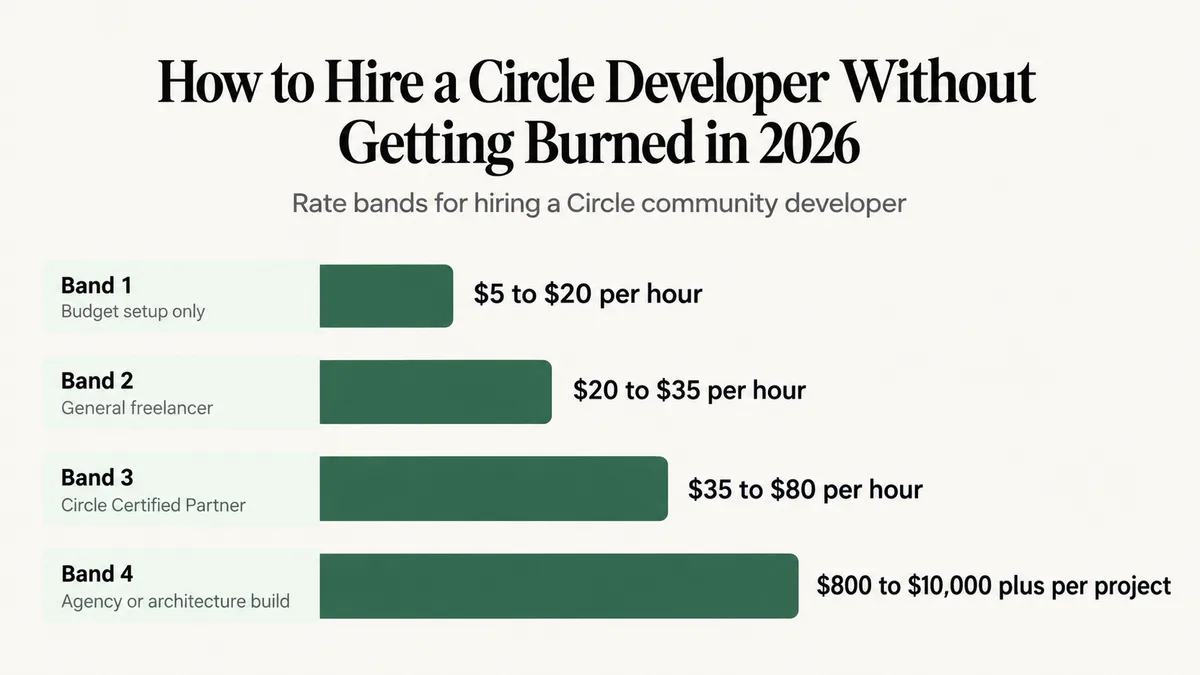
$5 to $20 per hour: budget setup and content loading. Can follow a template and load spaces. Not the person to design your access logic or your automations.
$20 to $35 per hour: a competent general freelancer who can structure spaces, set up courses, and configure Zapier-level automation. Fine for a straightforward community with no complex paywall logic.
$35 to $80 per hour: a Circle Certified Partner or genuine community architect with real API, Workflows, and payment-automation experience. One profile I checked while researching this piece, a Circle Certified Partner with Top Rated Plus status and over 150 completed jobs on Upwork, lists exactly this rate for this kind of work. This is the band most paid-membership businesses should be hiring in.
$800 to $10,000 or more per project: fixed-price architecture builds, full migrations, or ongoing engagement-and-automation systems, according to the project ranges Upwork’s own hiring guide publishes for Circle community work. Where your project lands in that range depends almost entirely on how much custom automation and access logic it needs, not on how many spaces you want.
Budget for the platform separately from the developer’s quote. Circle’s current plans run Professional at $89 per month, Business at $199, and Scale at $419, each billed annually at that rate, confirmed directly against Circle’s own pricing page. A custom branded mobile app sits on a separate, custom-quoted Circle Plus tier above that. The developer’s rate and the platform subscription are two different lines, and a quote that blends them without saying so is worth a direct question.
Step 1: Do You Need a Developer or a Community Manager?
Write down what actually needs to happen before you talk to anyone, because “I need help with my Circle community” describes at least two different hires. If the real need is moderation, event programming, member onboarding messages, and keeping engagement up day to day, that is a community manager, and the going rate for that role sits around $24 to $60 per hour for ongoing work.
If the real need is building or fixing the structure underneath, membership tiers, paywalled spaces, a purchase that should automatically grant access, a migration, an integration with your email tool or CRM, that is a developer or community architect, and it is priced and skilled differently from the manager role above.
Plenty of real projects need both, just not from the same person at the same rate. Hiring one person to do daily moderation at a developer’s hourly rate wastes money. Hiring a community manager to wire Stripe to your access tiers gets you a broken paywall. Worth checking first: if the real problem is a specific, isolated break, such as notifications not reaching members, that is usually a configuration fix, not a reason to open a full hiring search.
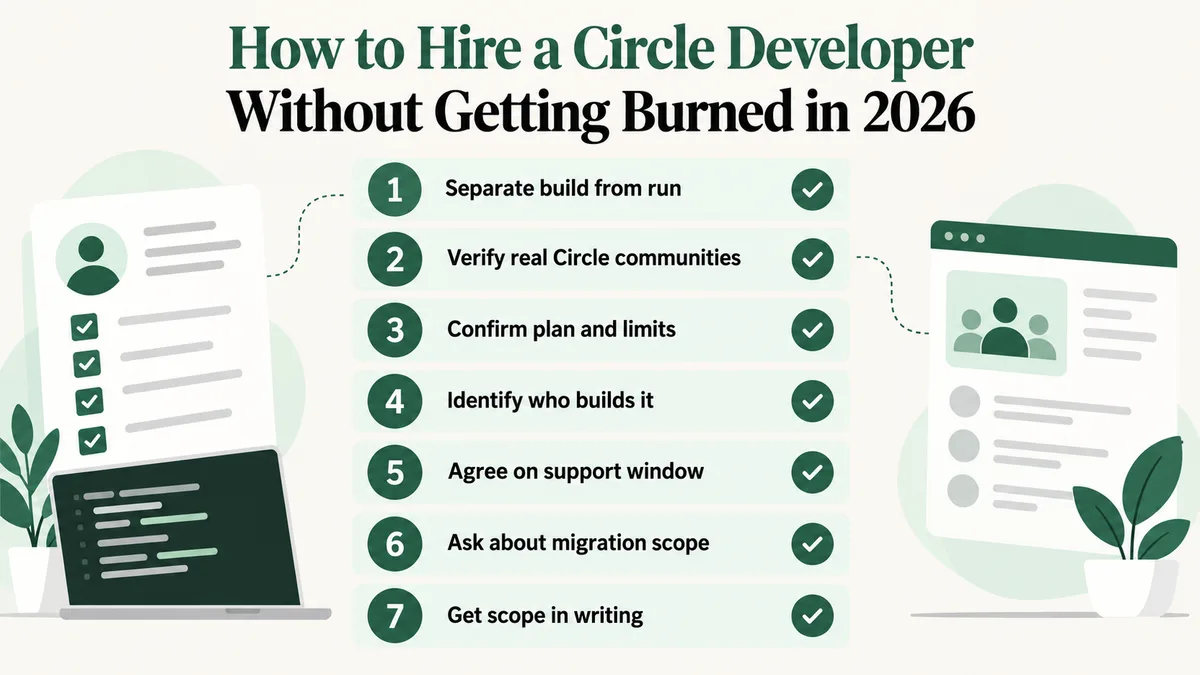
Do this: Separate your brief into a build list (one-time structure and automation work) and a run list (ongoing moderation and engagement). Hire against each list separately, even if it ends up being the same person.
Step 2: Have They Built Real Circle Communities You Can Open?
Ask for real community URLs, not screenshots of an admin dashboard. A public Circle community has a visible, consistent space structure you can click through yourself. A private one can still usually be verified by asking the candidate to walk you through its structure live on a screen share.
Then ask a harder question about one of those builds: what was the hardest access or automation problem on it, and how was it solved. Someone who actually built it answers with something specific and a little mundane, like a Workflow that had to check a member’s Stripe tier before granting a space, or a webhook that needed a retry because Circle’s own API rate-limited a bulk import. Someone who did not do the work answers in adjectives about how “engaged” the community felt.
If a related community platform is part of the comparison, the same verification logic applies to a Mighty Networks build: ask for the specific technical decision, not a general description of how active the members were.
Do this: Request two or three real Circle communities you can verify, and ask for the hardest access or automation problem solved on one of them. A vague answer is the fastest real warning sign you will get.
Step 3: Do They Understand Circle’s Real Plan Limits?
This question separates someone who has actually shipped on Circle from someone guessing, and you do not need to be technical to ask it. Ask which Circle plan your automation and integration needs actually require.
A real specialist knows the specifics. Workflows, Circle’s own internal automation builder, are not included at all on the entry Professional plan at $89 a month. They only appear on the Business plan at $199 a month, which includes 20 automations, and expand to unlimited on the $419 Scale plan, confirmed directly on Circle’s own pricing and plan-comparison page. The Circle API and MCP connection are Business-plan features too, while webhooks and custom single sign-on do not appear until Scale. Admin, moderator, and space limits also scale by plan: Professional caps at 3 admins and 20 spaces, Business at 5 admins and 30 spaces, Scale at 10 admins and 100 spaces.
If a candidate promises “full automation” without first asking which plan you are on or planning to be on, that promise is not realistic yet, because on the cheapest plan it is not technically possible. This single question, asked directly, filters out more unqualified candidates in this market than anything else on this list.
Do this: Ask which Circle plan your automation, API, or webhook requirements actually need, and listen for a specific answer naming Workflows, the API, or webhooks by plan tier rather than a generic “I can automate anything.”
Step 4: Who Is Actually Doing the Work?
A real and common pattern in this market: an agency or a generalist “community growth” consultancy sells the project, then quietly hands the technical build to a subcontractor the client never meets. You approve a confident proposal, and the actual Workflows configuration lands with someone who has never touched Circle’s API before.
You are allowed to ask who writes the automations and configures the integrations, whether that person works directly for the company you are hiring, and whether you can speak with them before signing. A developer who has genuinely done this work answers without hesitation, because the answer costs them nothing. Evasion on this specific question is one of the more reliable signals available to you in the whole process.
Time zone and response cadence belong in the same conversation. A multi-day gap on every clarifying question turns a two-week build into a two-month one, no matter how skilled the person is. Agree up front on how often you will hear from them and through which channel.
Do this: Get the name of the person actually building the automations and talk to them once before signing. Agree on a communication cadence in that same conversation.
Step 5: What Happens the Week After Launch?
Circle communities tend to fail in a specific, predictable pattern. They work perfectly in a walkthrough with a test account and start breaking once real members arrive, because real members do things a test account never does: they upgrade mid-month, a Stripe webhook fires out of order, or a Zapier automation hits an edge case nobody tested because nobody expected a member to do that specific thing on day one.
This is why post-launch support belongs in the product, not as an upsell added after the fact. Ask what is covered after handover, for how long, and at what cost beyond that window. “Everything is included forever” is either an answer from someone who has not thought it through or a developer planning to disappear. A clear answer sounds like two weeks of bug fixes included, then an hourly rate or a small monthly retainer for anything new.
Ask directly what happens if an automation breaks a month later because Circle itself shipped an update to its Workflows feature. Whether that is billable is worth clarifying in advance, and the specificity of the answer tells you how seriously the candidate takes their own work.
Do this: Get the support window, what counts as a bug fix versus new work, and the post-launch rate written into the agreement before the project starts, not after the first real member hits a problem.
Step 6: Do They Know What a Migration Actually Covers?
Circle is genuinely more generous here than some competing platforms. It runs its own free payment-migration service for eligible accounts, and a free course-migration service for annual Business-plan customers and above, confirmed directly on Circle’s own pricing page. That is real, worth knowing, and a fair question to raise before paying a developer to rebuild something Circle itself will move for free.
The part Circle’s own migration service does not touch is anything built on top of the old platform: custom automations, Zapier zaps pointed at the old tool, GoHighLevel or ActiveCampaign integrations keyed to the old member IDs, and any engagement or activity history that lived in the previous platform’s own database. A developer who has actually run one of these migrations names those gaps unprompted. One who says “everything moves over automatically” either has not done this before or is telling you what you want to hear.
This matters even on a brand-new build with no migration involved, because the same person who undersells migration risk tends to undersell every other risk in the project too. How a candidate talks about what breaks is a better signal than how they talk about what works.
Do this: If a migration is involved, ask what Circle’s own free migration service covers for your plan tier, then ask specifically what still needs to be rebuilt by hand on top of it.
Step 7: Is the Scope Written Down Before Money Moves?
Nearly every dispute I have seen between a creator and a Circle developer traces back to the same root cause: two different mental pictures of what “done” meant, and neither one written down anywhere.
The document does not need to be long. It needs a list of deliverables, a definition of done for each one, milestone dates, what you are responsible for supplying, and what a change request costs once work has started. Content is worth naming explicitly: writing space descriptions, recording welcome videos, and populating the first batch of posts is real work, and if nobody owns it, it lands on your desk the week before launch.
On payment structure, milestones tied to named deliverables protect both sides. Paying everything up front removes your own negotiating room entirely, and paying only on full completion is a reasonable thing for a good developer to decline on a longer build. A deposit with staged releases against specific milestones is the normal, healthy arrangement experienced developers already expect.
One more clause worth insisting on in writing: your Circle workspace, domain, and Stripe account stay registered to you, not to the developer. This is not about distrust. It is about never being locked out of your own community if the relationship ends badly.
Do this: Require a written scope with deliverables, milestone payments, a named owner for content, and written confirmation that your Circle workspace and connected accounts stay registered in your own name.
What Are the Red Flags That Should End the Conversation?
Some signals are worth walking away from immediately rather than negotiating around:
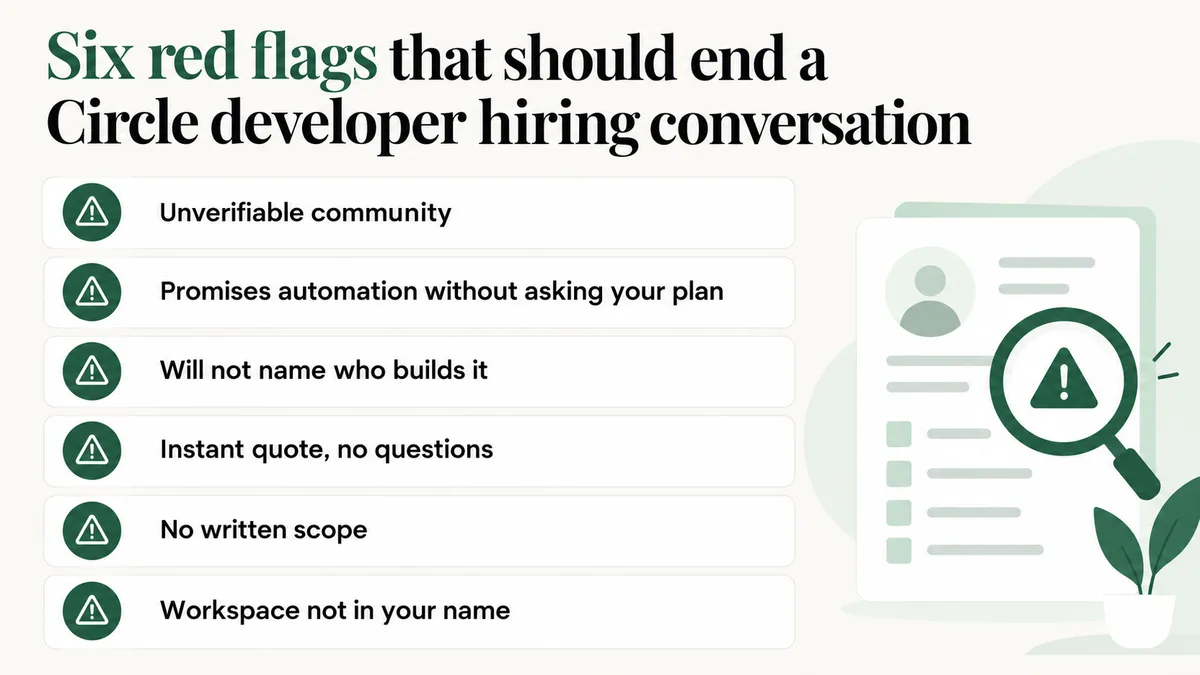
- Portfolio communities you cannot actually open or verify as real.
- A promise of full automation without ever asking which Circle plan you are on.
- Refusal to name the person doing the technical build or to put them on a short call.
- A total price quoted within minutes, before any real questions about tiers, payments, or migration.
- No written scope, only a chat thread and a number.
- Your own Circle workspace, domain, or Stripe account set up under the developer’s credentials instead of yours.
The instant-quote flag deserves a second look specifically because it looks like good service. A developer who prices a Circle build without asking about access tiers, automations, or migration is not being efficient. They are guessing, and that guess shows up later as a change order with a new price attached to it.
How Do You Screen Three Candidates in an Afternoon?
If you want the compressed version of everything above, run it in this order. It moves faster than comparing three separate proposals on your own, side by side.
- Confirm you are hiring a developer and not a community manager, or write down which parts of the project are each.
- Send the identical one-page brief to all three candidates.
- Ask for two or three real Circle communities and verify each one yourself.
- Ask what the hardest access or automation problem on one of those builds was, and listen for real specifics.
- Ask which plan your automation and API needs require, listening for Workflows, the API, or webhooks by name.
- Ask who writes the automations and request a short call with that person.
- Compare only the candidates still standing, on written scope rather than the headline price.
Most candidate lists lose at least one person at step three and another at step five. What remains afterward is a far more useful conversation, because by then you are no longer comparing marketing copy.
Where Should You Look When Deciding How to Hire a Circle Developer?
Circle runs its own Solution Partner Directory at circle.so/partner-directory, where agencies and specialists carry a Gold, Silver, or standard Circle Certified badge depending on their vetting tier. That is a reasonable first stop precisely because Circle itself does part of the vetting before you ever talk to anyone.
Beyond Circle’s own directory, the realistic sources are general freelance marketplaces such as Upwork and Fiverr, Circle’s own Academy-certified individuals, and dedicated community-architecture agencies that publish real case studies instead of generic service pages. Circle’s own customer community, open to any paying account, is also worth a look: how someone answers a stranger’s Workflows question in public tells you more than a polished sales page ever will.
Worth knowing before you search: general marketplaces do not pre-vet anyone, which is exactly why they list rates as low as five dollars an hour alongside genuine Circle Certified Partners charging well over ten times that for comparable work. The screening steps in this guide matter more on a general marketplace than anywhere else, because the marketplace itself is doing none of that screening for you.
Whichever source you choose, the standard you hold candidates to should not change. Working out how to hire a Circle developer is really a verification problem, not a sourcing problem. The source changes how many people you are choosing from, not how carefully you need to check each one.
How Do You Avoid Hiring the Wrong Person Twice?
The cheapest protection available is a small paid trial task before committing to the full build. Pay for something real and self-contained: configure one Workflow end to end, or fix one specific existing access issue. Two to three hours is usually enough to learn what you need to know.
That trial reveals four things no interview can. How someone communicates under real conditions, whether their time estimate held up, whether the work is genuinely finished when they say it is, and what their configuration looks like when nobody is reviewing it in real time. Paying for a small test costs far less than discovering the answers halfway through a full launch.
The second protection is keeping the first real engagement smaller than you eventually want it to be. Launch with fewer membership tiers or a simpler automation set than your long-term plan calls for. A two-tier launch that actually works beats a five-tier launch that half works, and it leaves you with a working relationship to expand rather than a large bet placed on a stranger.
Keep your own record of what got built and why: which Workflows, which integrations, which spaces map to which membership tier. Developers move on to other clients, and a Circle workspace nobody can explain becomes expensive for whoever inherits it next. A shared document maintained during the build costs nothing and saves real time later.
Frequently Asked Questions
Do I really need a Circle developer, or can I set it up myself?
For a single free community with no paywall and no outside integrations, most people can set it up themselves inside Circle’s own interface. Once you need paid membership tiers tied to automatic access, a migration, or anything connecting to an outside tool, hire someone with real Circle Workflows and API experience. Those systems fail quietly, and a community manager without that background often will not know something is broken until a paying member reports it.
How long should a Circle build take?
A straightforward single-tier community with standard spaces usually takes one to two weeks once content is ready. Migrations, custom Workflows, and multi-tier automation builds extend that meaningfully. Content and space-structure decisions are almost always the real bottleneck, not the configuration time itself.
Is a fixed price or an hourly rate better for a Circle project?
Fixed price works when the scope is genuinely well defined, which is exactly why the written brief in Step 1 matters. Hourly suits ongoing changes, moderation, or a scope that is still being figured out. A common, sensible arrangement is a fixed price for the defined build plus an hourly rate for anything added afterward.
What if my current Circle community was already set up badly?
Get an audit before deciding anything. Plenty of communities that feel broken need an access or automation fix rather than a full rebuild, and an audit tells you which situation you are actually in. Rebuild only when the underlying space or tier structure is genuinely unworkable, since untangling existing member data is the hardest part of any rescue project.
Should I hire a freelancer or a Circle agency?
A freelancer usually costs less and gives you direct access to the person doing the work. An agency, especially one listed in Circle’s own Solution Partner Directory, offers more continuity if one person leaves and more capacity for a larger project. For most single-brand membership communities, an experienced freelancer or a small specialist team wins on both price and communication.
What is the fastest way to spot a fake Circle specialist?
Two questions do most of the work. Ask which Circle plan your automation requirements actually need, and ask what the hardest access or automation problem was on a specific past build. Someone who has genuinely done this work answers both immediately and specifically. Someone who has not stays vague on both, usually with a confident tone doing the work the details should be doing instead.
Want a second opinion before you sign anything?
Send me the brief and the quotes. I will tell you honestly whether the scope is realistic and what is missing from it, whether or not you end up working with me.