
Someone asks me how much does Laravel development cost almost every time a WordPress site or a no-code platform has started holding their business back. The honest answer is never a single number, because “Laravel development” covers everything from a two-week internal tool to a multi-month platform rebuild, and the quotes I see floating around online span a genuinely absurd range because of it.
I have quoted this work, and I have been brought in to rescue projects where a cheap quote turned into a much more expensive rebuild six months later. What follows is the real spread of 2026 rates, what actually moves a number up or down, and the costs that never make it onto the first invoice.
Quick Answer
Laravel development costs roughly $15 to $50 per hour from offshore teams in South and Southeast Asia, $40 to $90 per hour from nearshore developers in Eastern Europe and Latin America, and $85 to $220 per hour from senior developers and agencies in North America and Western Europe. Fixed-price projects usually run $8,000 to $40,000 for a genuine custom web application, $2,000 to $8,000 for a smaller internal tool or integration, and well into six figures for a multi-module platform. The number that actually matters is not the hourly rate, it is how precisely the scope is written down before anyone starts billing.
📋 What’s Covered
02How Much Does Laravel Development Cost per Hour in 2026?
03What Do Common Laravel Projects Cost as a Fixed Price?
04Why Do Laravel Rates Vary So Much by Region?
05What Makes One Laravel Quote Triple Another?
06What Hidden Costs Do Most Laravel Quotes Leave Out?
07When Should You Move From WordPress or No-Code to Custom Laravel?
08How Do You Vet a Laravel Developer Before Paying Anything?
09Why Does the Cheapest Laravel Quote Usually Cost More Later?
10How Do You Keep Laravel Costs Predictable Long Term?
11Frequently Asked Questions
What Actually Counts as “Custom Laravel Development”?
This is the first confusion to clear up, because it changes every number that follows. Laravel is a PHP framework, not a product. There is no theme store, no drag-and-drop page builder, and no monthly subscription that unlocks features. Every screen, every database table, and every workflow is written specifically for the business that pays for it.
That means the work people hire a Laravel developer for splits into a few genuinely different categories, and they do not cost the same.
A small internal tool: a booking system, an inventory tracker, a reporting dashboard that pulls from one or two data sources. Scoped and bounded, the cheapest real category.
A customer-facing web application: a portal, a membership system, a marketplace, something real users log into and depend on. Needs real authentication, real testing, and a plan for what happens when something breaks at 2am.
A replacement for a no-code or WordPress stack: migrating logic that currently lives across plugins, Zapier, and spreadsheets into one coherent system. Part development, part untangling years of workarounds.
A multi-module platform: several of the above wired together, often with APIs to outside services, role-based permissions, and a real roadmap beyond launch day. The most expensive category, and the one where scope creep does the most damage.
A quote that does not ask which of these four you actually need is a guess wearing a dollar sign. The gap between the first and the last is not a premium, it is a different job with a different team behind it.
How Much Does Laravel Development Cost per Hour in 2026?
Hourly rates settle into four honest bands. Where someone sits has as much to do with the quality of their process as their location, though location still moves the number more than anything else.
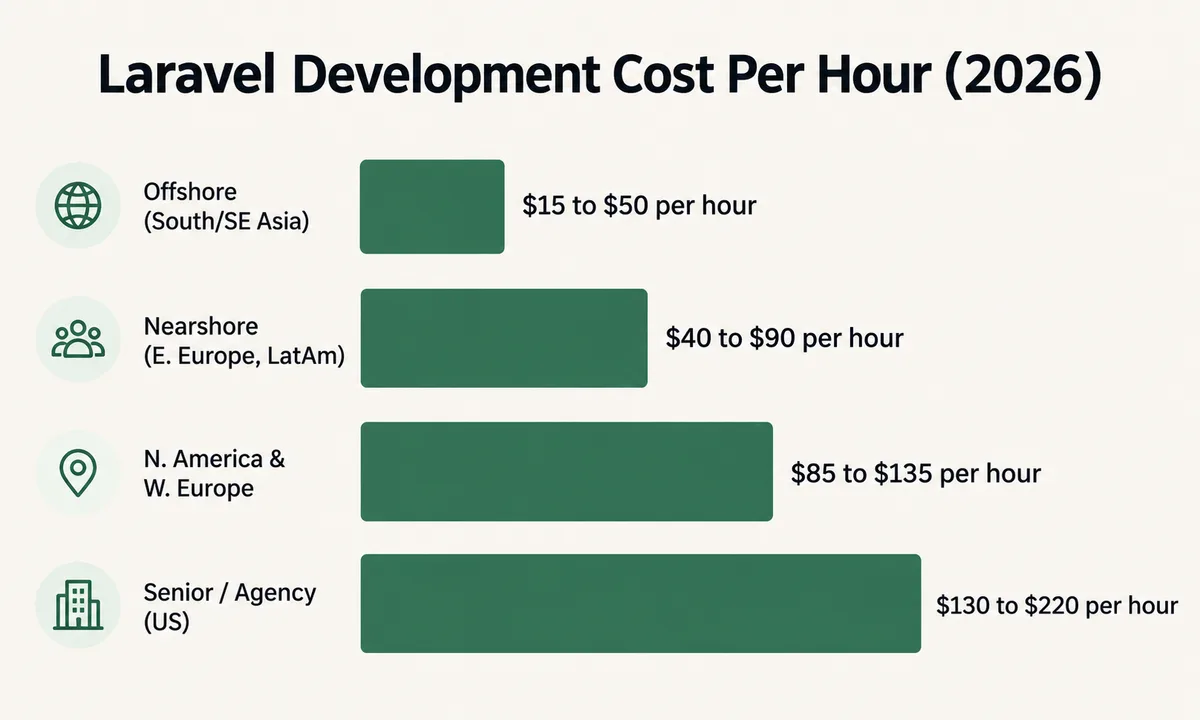
$15 to $50 per hour: offshore developers, largely in South and Southeast Asia. Genuinely capable of solid CRUD applications and standard Laravel patterns. The risk here is process, not syntax: communication gaps and thinner testing discipline show up on anything with real business logic.
$40 to $90 per hour: nearshore developers in Eastern Europe and Latin America. This is where most mid-sized custom builds land, with a real mix of senior individual freelancers and small studios.
$85 to $135 per hour: mid-level to senior Laravel developers in North America and the UK. Rate research from Second Talent’s Laravel hiring data places this exact range as the realistic working band for solid talent in these markets, with Western Europe running close behind it.
$130 to $220 per hour: senior US-based specialists and established agencies, usually attached to a named portfolio, a real process, and accountability if something ships broken. This band buys judgment as much as code.
One number worth naming directly: junior developers anywhere in the world can genuinely charge $10 to $15 an hour. That rate is fine for following clear instructions on a well-scoped task. It is the wrong purchase for a project where nobody has written the instructions yet, because that thinking work is exactly what the higher bands are pricing in.
What Do Common Laravel Projects Cost as a Fixed Price?
Most real Laravel work is sold as a fixed-price project once scope is written down, so the hourly bands above are mostly a sanity check on the total. Here is the realistic shape of those quotes.
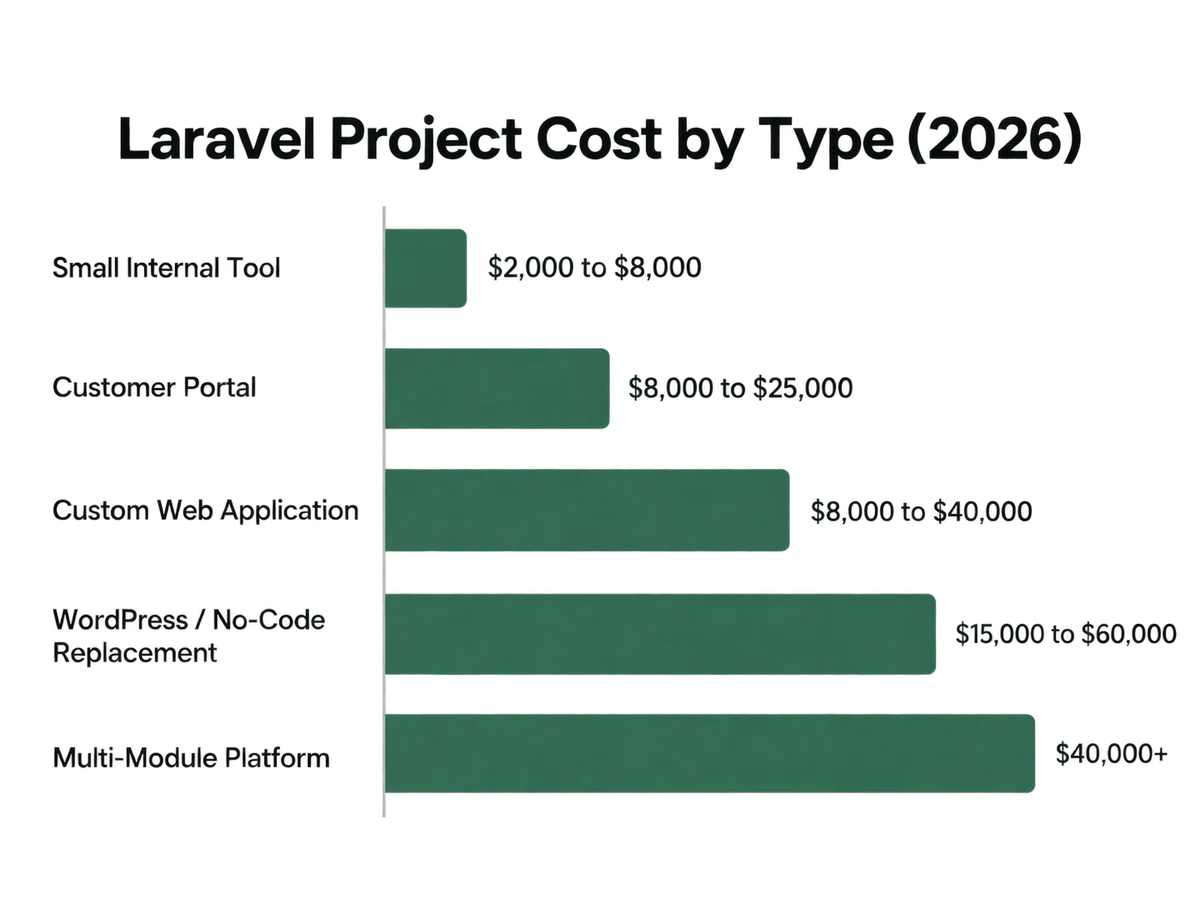
- Small internal tool: $2,000 to $8,000. One clear workflow, limited users, minimal integrations.
- Customer-facing portal or membership system: $8,000 to $25,000. Real authentication, role permissions, and a production-grade front end.
- Custom web application: $8,000 to $40,000 or more, depending on the number of workflows and integrations involved. This matches the real industry range confirmed across multiple 2026 cost guides for genuine custom builds.
- WordPress or no-code replacement: $15,000 to $60,000. Rebuilding the logic is one project; migrating years of content and user data without breaking anything is a second, often underquoted, project layered on top.
- Multi-module platform: $40,000 well into six figures. Several of the above wired together, with APIs, admin tooling, and a real roadmap beyond the first release.
Ongoing retainers for bug fixes, small features, and security updates typically run $1,000 to $5,000 a month depending on how actively the system changes. For anything that holds real customer data, that retainer is not optional spend, it is the cost of the system staying trustworthy.
Treat every number above as a starting shape. The real variance inside each range comes almost entirely from the cost drivers further down this page, not from negotiating a rate.
Why Do Laravel Rates Vary So Much by Region?
Location is the single biggest lever on the hourly number, and it is worth understanding why before you pick a team purely on price.
Cost of living explains most of the spread. A developer in Lahore or Manila can do excellent work at $20 an hour because that rate supports a comfortable local income, while the same rate in San Francisco or London would not cover rent. Neither fact says anything about skill on its own. It explains the floor and ceiling of the market, not where a specific person or studio sits inside it.
What location does correlate with, imperfectly but genuinely, is process maturity: documented testing, code review discipline, and how a team handles a requirement that turns out to be ambiguous mid-project. Offshore teams with strong process exist, and expensive teams with weak process exist too. The region tells you the price range to expect. It does not tell you which individual team you are looking at, which is exactly why the vetting checklist later in this post matters more than the hourly number by itself.
Do this: Pick your rate band based on what the project can tolerate if something ships wrong, not on the lowest number you can find. A $2,000 internal tool can absorb a rough edge. A $30,000 customer portal usually cannot.
What Makes One Laravel Quote Triple Another?
When two quotes for what sounds like “the same project” come back three times apart, it is almost always one of these six things.
- How well the scope is actually written. “Build me a customer portal” and a documented list of screens, roles, and workflows are not the same brief, and they never get priced the same way.
- Data migration. Writing new code is predictable. Moving years of inconsistent data out of WordPress tables or a legacy database without losing or corrupting records is the part that blows up timelines.
- Number of third-party integrations. Every payment gateway, CRM, or external API is its own small project, with its own failure modes to handle, not just a connection to wire up.
- Testing and quality expectations. Automated test coverage, staging environments, and a real QA pass add real hours. Skipping them is how a cheap quote stays cheap, and how bugs reach production.
- Security and compliance requirements. Payment data, health information, or anything touching GDPR-style obligations adds real engineering work that a generic quote usually never accounted for.
- Post-launch ownership. A quote that ends at deployment and one that includes documentation, handover, and a defined support window are different products, even when the code underneath looks identical.
Send every candidate the same written brief covering those six points. Quotes are only comparable once the inputs are identical, and how a developer responds to a real brief tells you more than any sales call will.
What Hidden Costs Do Most Laravel Quotes Leave Out?
These line items rarely appear on a first proposal, and they catch people out in the exact same order every time.
- Hosting and infrastructure. Laravel needs a real server environment, not shared WordPress hosting. Budget $20 to $200+ a month depending on traffic, separate from the build cost.
- Third-party service fees. Transactional email, file storage, payment processing, and monitoring tools each carry their own small recurring bill once the app is live.
- Documentation and handover. Code with no written explanation of how it works is a liability the moment the original developer becomes unreachable.
- Security patching. Laravel itself, every package it depends on, and the PHP version underneath all need periodic updates. Skipped for a year, this becomes a real, expensive risk rather than a convenience.
- Your own review time. Testing flows, approving designs, and answering clarifying questions is real work on your side. A project stalls in your inbox as easily as in a developer’s queue.
None of this makes custom development a bad decision. It just belongs in the first budget conversation, not discovered in month three.
When Should You Move From WordPress or No-Code to Custom Laravel?
Not every business that feels frustrated with its current stack needs a custom rebuild. Run through these signals before you spend anything.
- Your business logic now lives across five or more plugins, each patched together with Zapier or Make, and nobody fully understands how they interact anymore.
- Page load times or admin performance degrade noticeably as data volume grows, and no hosting upgrade has fixed it.
- You need a workflow or permission structure no plugin on the market actually supports, and you have genuinely searched.
- A plugin update has broken production more than once in the last year, and you are effectively maintaining someone else’s unfinished software for free.
- The platform subscription cost is climbing toward what a custom build’s hosting and maintenance would actually cost, with no ceiling on where it stops.
- You are building something genuinely new to your market, where a template was never going to exist in the first place.
If two or more of those are true, the conversation about custom development is worth having seriously. If none of them are, the honest advice is to stay where you are. I have talked clients out of a rebuild more than once, because the actual problem was a misconfigured plugin, not the platform itself.
How Do You Vet a Laravel Developer Before Paying Anything?
Run through these in order. It takes an afternoon and removes most of the real risk in the decision.
- Ask for two or three live applications they built, not screenshots, and actually use them.
- Ask what testing approach they use, specifically, and whether automated tests exist for the systems they are showing you.
- Ask who owns the code, the server, and the domain once the project is finished. The honest answer is always: you.
- Ask what the hardest bug on a past project was, and how they found it. Specific, slightly boring answers are the real signal.
- Check real community presence: a GitHub profile with genuine history, or activity on the official Laravel Partners directory if they claim agency status.
- Ask what happens after launch, for how long, and at what rate once that window closes.
- Pay for a small, paid trial task before committing to the full project. A few hours of real work shows more than any interview does.
On the portfolio check specifically, insist on real specificity, not a generic “we build custom web apps” line. Vague answers are the fastest disqualifier there is.
Why Does the Cheapest Laravel Quote Usually Cost More Later?
The $15 an hour quote is real, and for the right scope it is genuinely a fine purchase. For a system holding real customer data and real business logic, it is usually the most expensive option, just not on the first invoice.
The reason is structural. A rushed build often still looks correct in a demo. What it actually contains is untested edge cases, a database schema that cannot grow cleanly, and zero documentation of why anything was built the way it was. Those problems do not surface in week one. They surface six months in, once real users and real data are already depending on the system.
Fixing that costs more than building it correctly once, for a reason that has nothing to do with hourly rates: the second developer has to reverse-engineer the first developer’s undocumented decisions before they can safely change anything. By then, a rebuild from scratch usually is not an option, because real customers are sitting inside the old structure. I have been the second developer on exactly this situation more than once, and the repair invoice is always larger than the original build would have been.
How Do You Keep Laravel Costs Predictable Long Term?
Four habits keep this budget sane over time, and none of them involve squeezing a rate down.
First, launch the smallest real version of the system, not the full vision. A working core that solves the actual bottleneck beats a half-finished platform with every feature half-built. It also means your first round of real-world fixes is cheap rather than catastrophic.
Second, insist on automated tests for anything touching money, user access, or data integrity. Tests cost real hours up front and save far more hours every time the system changes afterward.
Third, keep a living document of what was built: which roles can do what, which integrations exist, and where configuration lives. One shared page maintained during the build saves days of reverse engineering for whoever touches the system next, including a future version of your own team.
Fourth, own every account from day one. The server, the domain, the repository, and every third-party service should be registered under your name, not your developer’s. This has nothing to do with distrust. It is about never being locked out of your own business if the relationship ends.
Do this: Require a written scope with named deliverables, a defined testing standard, a fixed number of revision rounds, and explicit confirmation that every credential and account is registered in your name before the first invoice is paid.
Frequently Asked Questions
Is Laravel development more expensive than WordPress?
Usually yes on build cost, because WordPress reuses existing plugins and themes while Laravel builds everything from scratch. The trade is flexibility and long-term control: WordPress hits a ceiling when a business needs logic no plugin supports, and that ceiling is exactly what pushes businesses toward custom development in the first place.
How long does a typical Laravel project take?
A small internal tool is usually two to four weeks. A customer-facing portal or membership system typically runs six to twelve weeks. A full platform rebuild or a WordPress migration with real data involved commonly takes three to six months, with data migration and testing as the most common source of delay.
Should I hire a freelancer or an agency for Laravel development?
A single experienced freelancer works well for a well-scoped, single-module project. An agency makes more sense once the project needs several specialties at once, such as front-end, DevOps, and QA working in parallel, or when continuity matters if one person becomes unavailable mid-project.
Does the Laravel developer cost include hosting?
Almost never. Development quotes cover building the application. Hosting, domain, email service, and any third-party API fees are separate recurring costs that typically run from $20 a month for a small app to several hundred dollars a month for something with real traffic.
Can a Laravel application later be scaled up if the business grows?
Yes, and this is one of Laravel’s real advantages over a no-code platform: because you own the full codebase and database, scaling is an engineering decision, not a plan upgrade with a hard ceiling. The cost of scaling well depends entirely on whether the original build used clean architecture and real tests, which is why cutting corners early is the expensive choice.
Where can I find a legitimate Laravel developer or agency?
The official Laravel Partners directory lists agencies vetted by the framework’s own team, and review platforms such as Clutch and GoodFirms list independently reviewed Laravel companies with real client feedback. Treat any of these as a starting point for the vetting steps in this article, not a substitute for them.
Not sure if your quote is fair, or if you even need a rebuild?
Send me the brief and the numbers you have been given. I will tell you honestly what the scope is missing and whether custom development is actually the right call, whether or not you end up hiring me.
Or see how this fits alongside the rest of what I build
Custom platforms, LMS builds, and the automation layered behind them, all scoped against a written brief with no upgrade surprises halfway through. I previously broke down what a Kajabi developer costs and what a GoHighLevel developer costs for the same reason: knowing the real range before you hire is the single biggest cost protection there is.